Create an account
Welcome! Register for an account
La password verrà inviata via email.
Recupero della password
Recupera la tua password
La password verrà inviata via email.

-
- container colonna1
- Categorie
- #iorestoacasa
- Agenda
- Archeologia
- Architettura
- Arte antica
- Arte contemporanea
- Arte moderna
- Arti performative
- Attualità
- Bandi e concorsi
- Beni culturali
- Cinema
- Contest
- Danza
- Design
- Diritto
- Eventi
- Fiere e manifestazioni
- Film e serie tv
- Formazione
- Fotografia
- Libri ed editoria
- Mercato
- MIC Ministero della Cultura
- Moda
- Musei
- Musica
- Opening
- Personaggi
- Politica e opinioni
- Street Art
- Teatro
- Viaggi
- Categorie
- container colonna2
- Servizi
- Sezioni
- container colonna1




Pseudonature – National Pavilion of Bulgaria
The project challenges the future of sustainability in a world where natural processes are increasingly mediated by artificial intelligence and human intervention. “Pseudonature” is more than an architectural experiment – it is a call to rethink our agency in shaping the world.
Comunicato stampa
Condividi l'evento
Pavilion of the Republic of Bulgaria at the 19th International Architecture Exhibition – La Biennale di Venezia
10 May – 23 November, 2025
Official inauguration: 9 May
Location: Sala Tiziano at the Centro Culturale Don Orione Artigianelli Fondamenta Delle Zattere Ai Gesuati 919, 30123 Venezia VE, Italy
PSEUDONATURE
A project by architect Iassen Markov
The Bulgarian Pavilion at the Biennale Architettura 2025 presents Pseudonature, an experimental
installation at the intersection of nature and technology, reality and simulation. Conceived by
architect Iassen Markov, the project challenges the future of sustainability in a world where natural
processes are increasingly mediated by artificial intelligence and human intervention.
A Climate Paradox: When the Sun Creates Snow
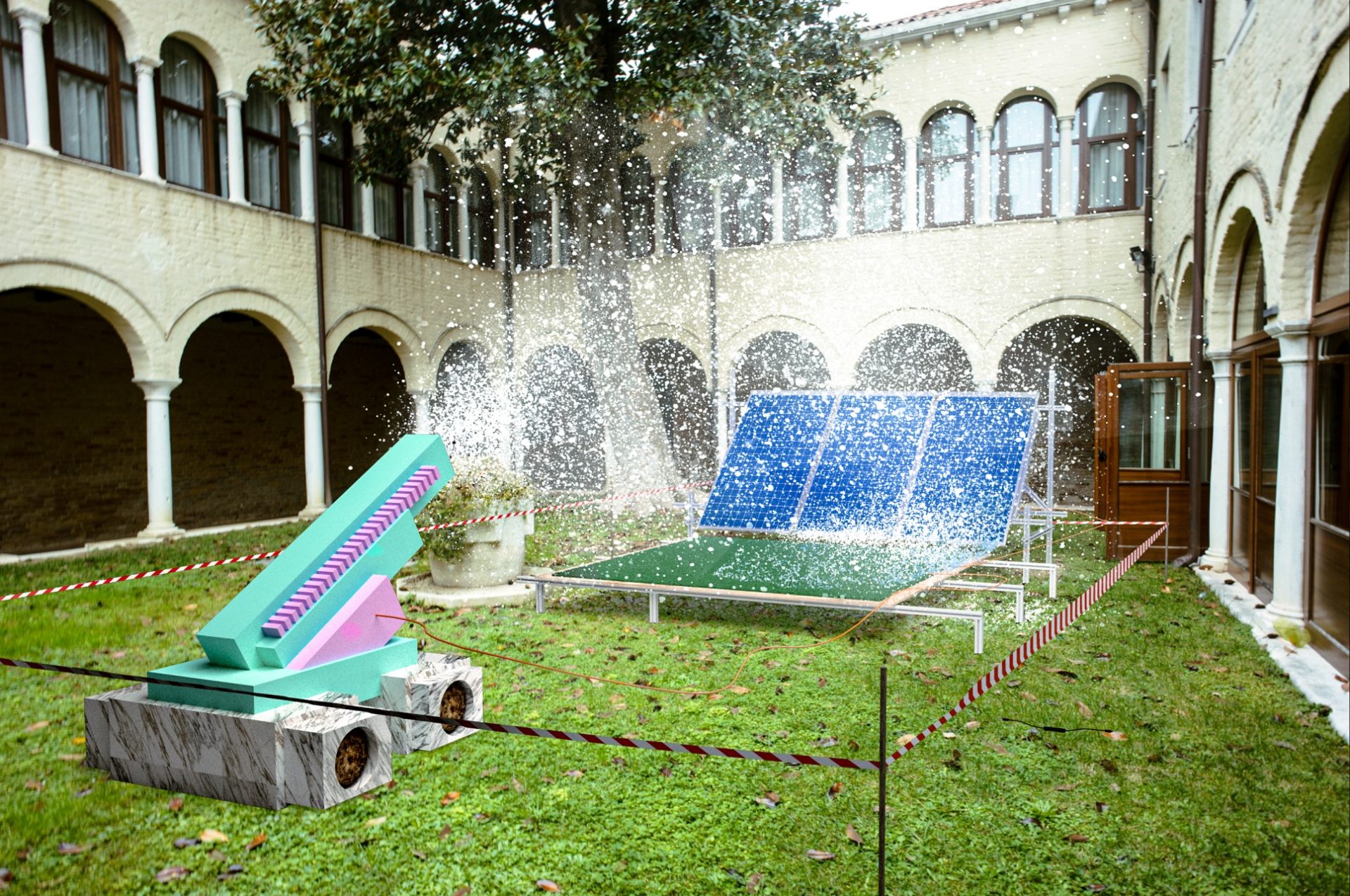
At the core of Pseudonature lies a striking contradiction: a snow-covered courtyard in the height
of summer in Venice. A solar-powered snow-making machine produces artificial snowfall—only
to bury the very panels that sustain it. The sun becomes both creator and destroyer, driving the
system while simultaneously erasing its own work. This self-regulating cycle reveals the fragile
equilibrium of sustainable technology: the stronger the sun, the more efficiently the system
operates, yet as snow accumulates, energy production slows, requiring constant adaptation to
shifting conditions. The project raises fundamental questions: Do we control nature, or are we
merely balancing on the edge of its ever-changing forces?
Interior: A Reimagined Traditional Space
Inside the pavilion, an abstract interpretation of the traditional Bulgarian odaya (living room) invites
visitors into a space of reflection, discussion, and collective thought. Once the heart of the
Bulgarian home, the odaya has always been a place for conversation, interaction, and the
exchange of ideas—now reimagined as a meeting point where natural, artificial, and collective
intelligence come together to shape new possibilities for the future.
At its center, a virtual fireplace flickers, generated by AI yet devoid of warmth, underscoring the
artificiality of this reconstructed environment. A handcrafted carpet by artist Rosie Eisor weaves
together tradition and digital aesthetics, reinforcing the dialogue between the organic and the
synthetic. Just as the fragile balance outside is constantly shifting between sun, snow, and energy,
the odaya reflects the equally complex struggle to find harmony between different forms of
intelligence. Eisor’s carpet illustrates this tension through three mythological monsters, locked in
a battle and bound together by a serpent—an allegory for the intricate and sometimes conflicting
relationship between human, artificial, and environmental intelligence.
Catalog: Radical Recipes for a Better Climate
Beyond the physical installation, Pseudonature presents Radical Recipes for a Better Climate -
an intellectual cornerstone of the Bulgarian Pavilion. This catalog gathers diverse "recipes" from
architects, designers, and scientists—individual strategies for sustainable adaptation. These
contributions are then fused into a collective recipe, generated by artificial intelligence, revealing
how AI can synthesize human insight into a shared vision for resilience. The result is a dynamic
interplay between personal expertise and machine-driven synthesis, exploring new ways to
navigate an uncertain climate future. A series of curated image sequences further amplifies the project's atmosphere. They blend speculative visuals with documentary fragments to evoke the
fragility and potential of our evolving relationship with nature and technology.
Beyond Installation: A Platform for Reflection
The installation’s aesthetic deliberately evokes a construction site - bricks, aluminum profiles, and
polycarbonate elements emphasize the human-made nature of the climate paradox. This raw,
DIY aesthetic exposes the provisional, sometimes haphazard way we intervene in natural
systems, highlighting the tension between control and uncertainty. Outside, physical interventions
disrupt natural balances, revealing the fragile interplay between technology and the environment.
Inside, the space shifts to a realm of contemplation, where the challenge of restoring equilibrium
becomes a mental and collective endeavor. Pseudonature makes clear: Just as we shape the
world outside, our ability to navigate and reconcile the contradictions we create begins within.
Pseudonature: A Call to Rethink Our Role
Pseudonature is more than an architectural experiment - it is a call to rethink our agency in
shaping the world. As the boundaries between nature and technology dissolve, the project lays
bare the paradoxes we create and the fragile balances we navigate. Sustainability is no longer
just about preservation, but about adaptation, reinvention, and the dynamic interplay between
human ingenuity, artificial intelligence, and the forces of the natural world.
About Iassen Markov
Iassen Markov (b. 1980, Sofia) is an architect and designer based in Munich, Stuttgart, and Sofia.
A graduate of the University of Stuttgart, his work spans academia, corporate architecture, and
experimental design. He has taught at leading institutions, including the Technical University of
Munich, the University of the Arts Zurich, and the Architectural Association in London.
With extensive experience in brand and corporate architecture, he has contributed to large-scale
projects for global industries. However, instead of following the well-worn path of commercial
design, he shifted his focus to deeper, more critical explorations of space, technology, and
ecology. As co-founder of IMPERIA Holding Group and CEO of Technobeton, he now develops
experimental architectural and artistic projects exhibited across Europe. His work challenges
conventional narratives, engaging with cultural transformations and the evolving relationship
between nature and artificial intelligence—an approach that continues to unfold in Pseudonature
and beyond.
BULGARIA
Pseudonature
Commissioner: Alexander Staynov;
Curator: Iassen Markov; Exhibitors: Technobeton, Rosie Eisor
Venue: Sala Tiziano-Centro Culturale Don Orione Artigianelli, Fondamenta Delle Zattere Ai Gesuati 919
CONTACTS:
For press inquiries, interviews, and further information, please contact:
Mila Rosen Mihaylova
mila.rosen.mihaylova@gmail.com
00359899281054
Website: www.pseudonature.ai
Instagram: pseudonature.ai
10 May – 23 November, 2025
Official inauguration: 9 May
Location: Sala Tiziano at the Centro Culturale Don Orione Artigianelli Fondamenta Delle Zattere Ai Gesuati 919, 30123 Venezia VE, Italy
PSEUDONATURE
A project by architect Iassen Markov
The Bulgarian Pavilion at the Biennale Architettura 2025 presents Pseudonature, an experimental
installation at the intersection of nature and technology, reality and simulation. Conceived by
architect Iassen Markov, the project challenges the future of sustainability in a world where natural
processes are increasingly mediated by artificial intelligence and human intervention.
A Climate Paradox: When the Sun Creates Snow
At the core of Pseudonature lies a striking contradiction: a snow-covered courtyard in the height
of summer in Venice. A solar-powered snow-making machine produces artificial snowfall—only
to bury the very panels that sustain it. The sun becomes both creator and destroyer, driving the
system while simultaneously erasing its own work. This self-regulating cycle reveals the fragile
equilibrium of sustainable technology: the stronger the sun, the more efficiently the system
operates, yet as snow accumulates, energy production slows, requiring constant adaptation to
shifting conditions. The project raises fundamental questions: Do we control nature, or are we
merely balancing on the edge of its ever-changing forces?
Interior: A Reimagined Traditional Space
Inside the pavilion, an abstract interpretation of the traditional Bulgarian odaya (living room) invites
visitors into a space of reflection, discussion, and collective thought. Once the heart of the
Bulgarian home, the odaya has always been a place for conversation, interaction, and the
exchange of ideas—now reimagined as a meeting point where natural, artificial, and collective
intelligence come together to shape new possibilities for the future.
At its center, a virtual fireplace flickers, generated by AI yet devoid of warmth, underscoring the
artificiality of this reconstructed environment. A handcrafted carpet by artist Rosie Eisor weaves
together tradition and digital aesthetics, reinforcing the dialogue between the organic and the
synthetic. Just as the fragile balance outside is constantly shifting between sun, snow, and energy,
the odaya reflects the equally complex struggle to find harmony between different forms of
intelligence. Eisor’s carpet illustrates this tension through three mythological monsters, locked in
a battle and bound together by a serpent—an allegory for the intricate and sometimes conflicting
relationship between human, artificial, and environmental intelligence.
Catalog: Radical Recipes for a Better Climate
Beyond the physical installation, Pseudonature presents Radical Recipes for a Better Climate -
an intellectual cornerstone of the Bulgarian Pavilion. This catalog gathers diverse "recipes" from
architects, designers, and scientists—individual strategies for sustainable adaptation. These
contributions are then fused into a collective recipe, generated by artificial intelligence, revealing
how AI can synthesize human insight into a shared vision for resilience. The result is a dynamic
interplay between personal expertise and machine-driven synthesis, exploring new ways to
navigate an uncertain climate future. A series of curated image sequences further amplifies the project's atmosphere. They blend speculative visuals with documentary fragments to evoke the
fragility and potential of our evolving relationship with nature and technology.
Beyond Installation: A Platform for Reflection
The installation’s aesthetic deliberately evokes a construction site - bricks, aluminum profiles, and
polycarbonate elements emphasize the human-made nature of the climate paradox. This raw,
DIY aesthetic exposes the provisional, sometimes haphazard way we intervene in natural
systems, highlighting the tension between control and uncertainty. Outside, physical interventions
disrupt natural balances, revealing the fragile interplay between technology and the environment.
Inside, the space shifts to a realm of contemplation, where the challenge of restoring equilibrium
becomes a mental and collective endeavor. Pseudonature makes clear: Just as we shape the
world outside, our ability to navigate and reconcile the contradictions we create begins within.
Pseudonature: A Call to Rethink Our Role
Pseudonature is more than an architectural experiment - it is a call to rethink our agency in
shaping the world. As the boundaries between nature and technology dissolve, the project lays
bare the paradoxes we create and the fragile balances we navigate. Sustainability is no longer
just about preservation, but about adaptation, reinvention, and the dynamic interplay between
human ingenuity, artificial intelligence, and the forces of the natural world.
About Iassen Markov
Iassen Markov (b. 1980, Sofia) is an architect and designer based in Munich, Stuttgart, and Sofia.
A graduate of the University of Stuttgart, his work spans academia, corporate architecture, and
experimental design. He has taught at leading institutions, including the Technical University of
Munich, the University of the Arts Zurich, and the Architectural Association in London.
With extensive experience in brand and corporate architecture, he has contributed to large-scale
projects for global industries. However, instead of following the well-worn path of commercial
design, he shifted his focus to deeper, more critical explorations of space, technology, and
ecology. As co-founder of IMPERIA Holding Group and CEO of Technobeton, he now develops
experimental architectural and artistic projects exhibited across Europe. His work challenges
conventional narratives, engaging with cultural transformations and the evolving relationship
between nature and artificial intelligence—an approach that continues to unfold in Pseudonature
and beyond.
BULGARIA
Pseudonature
Commissioner: Alexander Staynov;
Curator: Iassen Markov; Exhibitors: Technobeton, Rosie Eisor
Venue: Sala Tiziano-Centro Culturale Don Orione Artigianelli, Fondamenta Delle Zattere Ai Gesuati 919
CONTACTS:
For press inquiries, interviews, and further information, please contact:
Mila Rosen Mihaylova
mila.rosen.mihaylova@gmail.com
00359899281054
Website: www.pseudonature.ai
Instagram: pseudonature.ai
10
maggio 2025
Pseudonature – National Pavilion of Bulgaria
Dal 10 maggio al 23 novembre 2025
architettura
Location
Sala Tiziano – Centro Culturale Don Orione
Venezia, Fondamenta Zattere Ai Gesuati, 919, (VE)
Venezia, Fondamenta Zattere Ai Gesuati, 919, (VE)
Orario di apertura
Wednesday - Monday, closed on Tuesday
From 10 May to 28 September:
11 a.m. – 7 p.m.
from 29 September to 23 November:
10 a.m. – 6 p.m.
Sito web
Autore
Curatore
Produzione organizzazione