Create an account
Welcome! Register for an account
La password verrà inviata via email.
Recupero della password
Recupera la tua password
La password verrà inviata via email.

-
- container colonna1
- Categorie
- #iorestoacasa
- Agenda
- Archeologia
- Architettura
- Arte antica
- Arte contemporanea
- Arte moderna
- Arti performative
- Attualità
- Bandi e concorsi
- Beni culturali
- Cinema
- Contest
- Danza
- Design
- Diritto
- Eventi
- Fiere e manifestazioni
- Film e serie tv
- Formazione
- Fotografia
- Libri ed editoria
- Mercato
- MIC Ministero della Cultura
- Moda
- Musei
- Musica
- Opening
- Personaggi
- Politica e opinioni
- Street Art
- Teatro
- Viaggi
- Categorie
- container colonna2
- Servizi
- Sezioni
- container colonna1



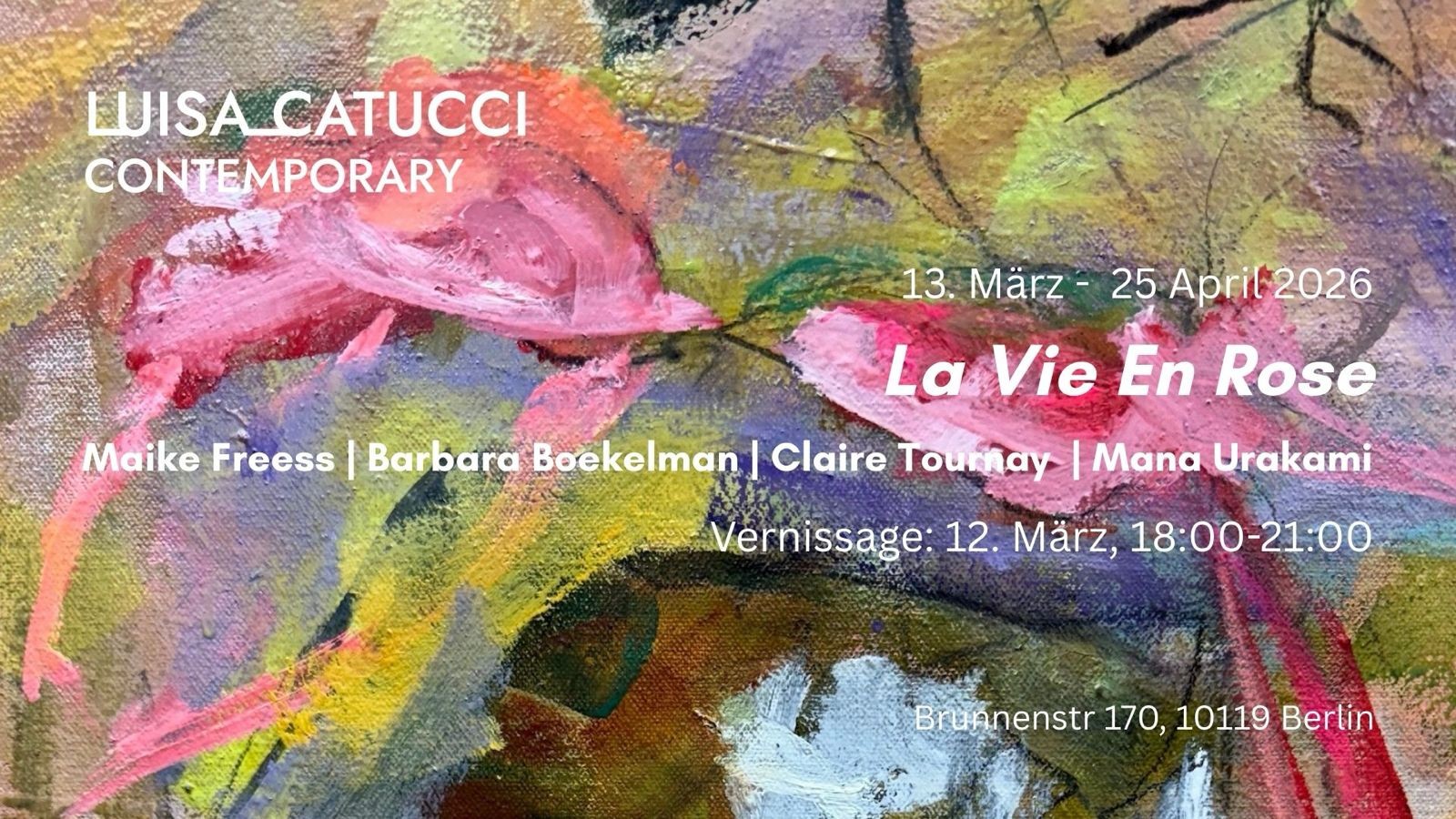
La Vie En Rose
“La Vie En Rose” inaugurates Luisa Catucci Contemporary, featuring Maike Freess, Barbara Boekelman, Mana Urakami, and Clara Tournay. The exhibition reclaims pink as a quiet force of resilience, exploring transformation and strength across diverse media.
Comunicato stampa
Condividi l'evento
La Vie En Rose - group exhibition
Curators: Luisa Catucci in collaboration with Mario Bermel
Every year, we return to this gesture.
A group exhibition of women artists — not as a statement, but as a necessity.
In 2026, this return coincides with a turning point. La Vie En Rose, featuring Maike Freess, Barbara Boekelman, Mana Urakami, and Clara Tournay, is the first exhibition presented under the name Luisa Catucci Contemporary, marking the transition from what was formerly Luisa Catucci Gallery.
What once operated as a conventional gallery has deliberately shed that skin. Luisa Catucci Contemporary now functions as an expanded platform for contemporary art — grounded in exhibitions, anchored in long-term artistic relationships, and opened toward knowledge exchange, shared learning, and community building. Masterclasses, courses, and moments of gathering are no longer side projects, but integral to a practice that understands art as something lived, transmitted, and sustained collectively.
Within this renewed framework, La Vie En Rose unfolds not as a theme but as a pulse. Pink runs through the exhibition like connective tissue — not decorative, not anecdotal, but insistently present.
In art history, pink has never been innocent. Born as a softened red, it once belonged to flesh, vitality, and spiritual embodiment, appearing in religious painting as a hue of incarnation rather than gender. In the Rococo, it bloomed into excess and pleasure — silk, skin, ornament, desire — a color of power dressed as refinement. Only later, with the rise of bourgeois norms, industrial production, and consumer culture, was pink disciplined into a symbol of femininity, sweetness, and compliance. A color trained to behave. As a gender was expected to behave.
Here, it does not.
Across the works of Maike Freess, Barbara Boekelman, Mana Urakami, and Clara Tournay — spanning painting, drawing, embroidery on photography, and sculpture — pink thickens, stains, interrupts. It holds delicacy without surrender, intimacy without fragility. Strength does not cancel tenderness; it sharpens it.
The title echoes the song made immortal by Édith Piaf, whose life stood far from romantic idealization. Marked by hardship, excess, loss, and relentless survival, Piaf embodied a form of resilience that gives the exhibition its undertone: softness as endurance, beauty as persistence.
The French title also quietly acknowledges transition on a personal level — the recent move of the exhibition’s collaborator, Mario Bermel, former Berlin gallerist, now Paris-based. A crossing rather than a conclusion, mirroring the exhibition’s own movement away from assigned meanings toward narratives claimed from within.
While Paris appears once more, this time biographically, in Maike Freess, who studied there and initiated her distinct artistic trajectory in the city, and in Clara Tournay, whose practice is currently taking shape in Paris, the binding force of the exhibition remains pink.
Pink, here, is stripped of infancy, of imposed gender roles, of its overused marketing gloss. Freed from sweetness and expectation, it becomes a color through which strength and resilience quietly surface — not as exception, but as a condition shared by women. In this exhibition, pink holds the weight of endurance, experience, and persistence, without needing to announce itself. Pink, here, is neither dominant nor demonstrative. In some works it barely appears, in others it lingers quietly — simply present. It does not need to be loud or assert itself, much like the strength it mirrors. This exhibition speaks of a resilience that stands on its own, without declaration, without opposition, without recourse to inherited clichés. A strength that has evolved — steady, self-possessed, and complete.
Maike Freess works with the human figure as a shifting terrain rather than a fixed form. Set against a plain black ground — recalling the darkness of the universe, a field of invisible matter — her drawings confront the viewer with bodies that appear, dissolve, and recompose, moving gradually from figuration toward abstraction. What is visible is never stable; it trembles between presence and disappearance. The fine white lines of her drawings, trace the figures like energetic photons, strokes of tension and movement that carve form out of void. Within this controlled constellation, color intervenes with precision and pink, holding a quiet yet decisive position, ignites the composition with life and material presence.
The works presented in La Vie En Rose — large-scale drawings and selected pieces from The Inheritors series — follow this cosmic balance, where bodies fragment and thin out, carrying inner states rather than narratives, suspended between force and refinement.
Barbara Boekelman works on a scale that addresses the body before the eye. Her large-format paintings unfold as apparently abstract fields, resisting immediacy; figuration emerges only through time, attention, and proximity. What first appears as gesture gradually reveals traces of bodies, presences, and emotional states embedded in the surface.
Her brushstroke is assertive and restless, carrying a controlled chaos. Pastel tones form a softened ground, counterpointed by vibrant passages and the deep black of charcoal, creating a friction between softness and abrasion. Pink acts as a binding presence throughout the compositions — at times settling gently like a skin bearing traces of lived stories, at others intensifying into reddish peaks that punctuate the surface with moments of tension and passion. In this oscillation between exposure and concealment, vulnerability is not staged, but wrested from the material itself.
Clara Tournay presents four sculptural works that exist in a state of transition. Abstract in form and precise in construction, her pieces unfold through contrasts of material: raw stone and marble meet plexiglass and polycarbonate surfaces coated with iridescent, petroleum-based reflective films. What appears solid is paired with what refracts; what feels ancient is set against what seems industrial and unstable.
Her sculptures do not assert a finished form, but register a passage. Light activates the surfaces, shifts perception, and destabilizes the boundary between matter and mirage. Pink, in her work, is never central or applied; it appears as reflection, as an emanated aura, surfacing only through the encounter between light, material, and movement.
Young and Paris-based, Tournay approaches sculpture as a site of quiet transformation. Her works feel less designed than grown, shaped by internal forces rather than formal intention. They inhabit an in-between state — between the organic and the constructed, the mineral and the synthetic — holding the tension of something still in the process of becoming.
Mana Urakami works in the space where images begin to fade. Photographs — sometimes found, sometimes made — are approached not as documents, but as fragile carriers of presence. Through hand embroidery, she intervenes with restraint, letting pastel-colored threads move quietly across their surfaces.
Her practice is guided by a distinctly Japanese sensibility — precise, attentive, and measured — where care is embedded in the gesture itself. Nothing is loud, nothing insists. Pastel-colored threads allow the works to unfold like hidden pearls, revealing themselves slowly and rewarding proximity and time rather than immediacy.
Guided by the idea that humans die twice — first physically, then through forgetting — Urakami rescues photographs abandoned by memory. Through embroidery, she offers them a third life. Here, the thread is no longer metaphorical: it becomes the actual bond, stitch by stitch, fastening what might have disappeared back into visibility, allowing these images to breathe once more and wait to become someone’s memory again.
Curators: Luisa Catucci in collaboration with Mario Bermel
Every year, we return to this gesture.
A group exhibition of women artists — not as a statement, but as a necessity.
In 2026, this return coincides with a turning point. La Vie En Rose, featuring Maike Freess, Barbara Boekelman, Mana Urakami, and Clara Tournay, is the first exhibition presented under the name Luisa Catucci Contemporary, marking the transition from what was formerly Luisa Catucci Gallery.
What once operated as a conventional gallery has deliberately shed that skin. Luisa Catucci Contemporary now functions as an expanded platform for contemporary art — grounded in exhibitions, anchored in long-term artistic relationships, and opened toward knowledge exchange, shared learning, and community building. Masterclasses, courses, and moments of gathering are no longer side projects, but integral to a practice that understands art as something lived, transmitted, and sustained collectively.
Within this renewed framework, La Vie En Rose unfolds not as a theme but as a pulse. Pink runs through the exhibition like connective tissue — not decorative, not anecdotal, but insistently present.
In art history, pink has never been innocent. Born as a softened red, it once belonged to flesh, vitality, and spiritual embodiment, appearing in religious painting as a hue of incarnation rather than gender. In the Rococo, it bloomed into excess and pleasure — silk, skin, ornament, desire — a color of power dressed as refinement. Only later, with the rise of bourgeois norms, industrial production, and consumer culture, was pink disciplined into a symbol of femininity, sweetness, and compliance. A color trained to behave. As a gender was expected to behave.
Here, it does not.
Across the works of Maike Freess, Barbara Boekelman, Mana Urakami, and Clara Tournay — spanning painting, drawing, embroidery on photography, and sculpture — pink thickens, stains, interrupts. It holds delicacy without surrender, intimacy without fragility. Strength does not cancel tenderness; it sharpens it.
The title echoes the song made immortal by Édith Piaf, whose life stood far from romantic idealization. Marked by hardship, excess, loss, and relentless survival, Piaf embodied a form of resilience that gives the exhibition its undertone: softness as endurance, beauty as persistence.
The French title also quietly acknowledges transition on a personal level — the recent move of the exhibition’s collaborator, Mario Bermel, former Berlin gallerist, now Paris-based. A crossing rather than a conclusion, mirroring the exhibition’s own movement away from assigned meanings toward narratives claimed from within.
While Paris appears once more, this time biographically, in Maike Freess, who studied there and initiated her distinct artistic trajectory in the city, and in Clara Tournay, whose practice is currently taking shape in Paris, the binding force of the exhibition remains pink.
Pink, here, is stripped of infancy, of imposed gender roles, of its overused marketing gloss. Freed from sweetness and expectation, it becomes a color through which strength and resilience quietly surface — not as exception, but as a condition shared by women. In this exhibition, pink holds the weight of endurance, experience, and persistence, without needing to announce itself. Pink, here, is neither dominant nor demonstrative. In some works it barely appears, in others it lingers quietly — simply present. It does not need to be loud or assert itself, much like the strength it mirrors. This exhibition speaks of a resilience that stands on its own, without declaration, without opposition, without recourse to inherited clichés. A strength that has evolved — steady, self-possessed, and complete.
Maike Freess works with the human figure as a shifting terrain rather than a fixed form. Set against a plain black ground — recalling the darkness of the universe, a field of invisible matter — her drawings confront the viewer with bodies that appear, dissolve, and recompose, moving gradually from figuration toward abstraction. What is visible is never stable; it trembles between presence and disappearance. The fine white lines of her drawings, trace the figures like energetic photons, strokes of tension and movement that carve form out of void. Within this controlled constellation, color intervenes with precision and pink, holding a quiet yet decisive position, ignites the composition with life and material presence.
The works presented in La Vie En Rose — large-scale drawings and selected pieces from The Inheritors series — follow this cosmic balance, where bodies fragment and thin out, carrying inner states rather than narratives, suspended between force and refinement.
Barbara Boekelman works on a scale that addresses the body before the eye. Her large-format paintings unfold as apparently abstract fields, resisting immediacy; figuration emerges only through time, attention, and proximity. What first appears as gesture gradually reveals traces of bodies, presences, and emotional states embedded in the surface.
Her brushstroke is assertive and restless, carrying a controlled chaos. Pastel tones form a softened ground, counterpointed by vibrant passages and the deep black of charcoal, creating a friction between softness and abrasion. Pink acts as a binding presence throughout the compositions — at times settling gently like a skin bearing traces of lived stories, at others intensifying into reddish peaks that punctuate the surface with moments of tension and passion. In this oscillation between exposure and concealment, vulnerability is not staged, but wrested from the material itself.
Clara Tournay presents four sculptural works that exist in a state of transition. Abstract in form and precise in construction, her pieces unfold through contrasts of material: raw stone and marble meet plexiglass and polycarbonate surfaces coated with iridescent, petroleum-based reflective films. What appears solid is paired with what refracts; what feels ancient is set against what seems industrial and unstable.
Her sculptures do not assert a finished form, but register a passage. Light activates the surfaces, shifts perception, and destabilizes the boundary between matter and mirage. Pink, in her work, is never central or applied; it appears as reflection, as an emanated aura, surfacing only through the encounter between light, material, and movement.
Young and Paris-based, Tournay approaches sculpture as a site of quiet transformation. Her works feel less designed than grown, shaped by internal forces rather than formal intention. They inhabit an in-between state — between the organic and the constructed, the mineral and the synthetic — holding the tension of something still in the process of becoming.
Mana Urakami works in the space where images begin to fade. Photographs — sometimes found, sometimes made — are approached not as documents, but as fragile carriers of presence. Through hand embroidery, she intervenes with restraint, letting pastel-colored threads move quietly across their surfaces.
Her practice is guided by a distinctly Japanese sensibility — precise, attentive, and measured — where care is embedded in the gesture itself. Nothing is loud, nothing insists. Pastel-colored threads allow the works to unfold like hidden pearls, revealing themselves slowly and rewarding proximity and time rather than immediacy.
Guided by the idea that humans die twice — first physically, then through forgetting — Urakami rescues photographs abandoned by memory. Through embroidery, she offers them a third life. Here, the thread is no longer metaphorical: it becomes the actual bond, stitch by stitch, fastening what might have disappeared back into visibility, allowing these images to breathe once more and wait to become someone’s memory again.
13
marzo 2026
La Vie En Rose
Dal 13 marzo al 25 aprile 2026
arte contemporanea
collettiva
collettiva
Location
Luisa Catucci Gallery
Berlin, Brunnenstraße, 170
Berlin, Brunnenstraße, 170
Orario di apertura
Wednesday - Friday
11:00 - 18:00
Saturday
12 : 00 - 17:00
Vernissage
12 Marzo 2026, 18:00 - 21:00
Autore
Curatore
Autore testo critico