Create an account
Welcome! Register for an account
La password verrà inviata via email.
Recupero della password
Recupera la tua password
La password verrà inviata via email.

-
- container colonna1
- Categorie
- #iorestoacasa
- Agenda
- Archeologia
- Architettura
- Arte antica
- Arte contemporanea
- Arte moderna
- Arti performative
- Attualità
- Bandi e concorsi
- Beni culturali
- Cinema
- Contest
- Danza
- Design
- Diritto
- Eventi
- Fiere e manifestazioni
- Film e serie tv
- Formazione
- Fotografia
- Libri ed editoria
- Mercato
- MIC Ministero della Cultura
- Moda
- Musei
- Musica
- Opening
- Personaggi
- Politica e opinioni
- Street Art
- Teatro
- Viaggi
- Categorie
- container colonna2
- Servizi
- Sezioni
- container colonna1



Alessandro Scarabello – Uppercrust
The Gallery Apart è orgogliosa di presentare Uppercrust, l’ultimo ciclo pittorico di Alessandro Scarabello, alla sua terza personale in galleria.
Comunicato stampa
Condividi l'evento
(english text below)
The Gallery Apart è orgogliosa di presentare Uppercrust, l'ultimo ciclo pittorico di Alessandro Scarabello, alla sua terza personale in galleria.
Uppercrust è l’espressione con cui nelle società anglosassoni vengono indicati gli appartenenti alle leading classes, la nuova aristocrazia che utilizza la propria posizione dominante in termini economici, finanziari, di comunicazione e quant’altro per influenzare le masse. L’espressione richiama le forme di pane che un tempo venivano cotte nelle cucine delle dimore nobiliari e che inevitabilmente presentavano un livello di cottura perfetto nella parte alta (uppercrust, appunto), destinata ai padroni, mentre la parte sottostante bruciata serviva a sfamare la servitù. Scarabello prosegue quindi la sua indagine sull’umanità, prende spunto dai movimenti di protesta diffusisi nel mondo durante questi anni di crisi e dalla rinnovata consapevolezza di chi fa parte di quel 99 per cento di persone che quotidianamente devono piegarsi alle regole, al potere e agli interessi del restante 1 per cento dell’umanità. Ed è proprio questo 1 per cento che diventa oggetto della sua ricerca. Scarabello crea così la serie Uppercrust, dodici grandi tele di cui quattro vengono esposte nella mostra in galleria. Sono ritratti di donne e uomini dipinti a grandezza naturale, di cui l’artista ci rende tutta l’altezzosa consapevolezza di appartenere ad una élite che può guardare il mondo dall’alto verso il basso e a cui il resto dell’umanità guarda con invidia e disprezzo ma anche con malcelata voglia di condivisione.
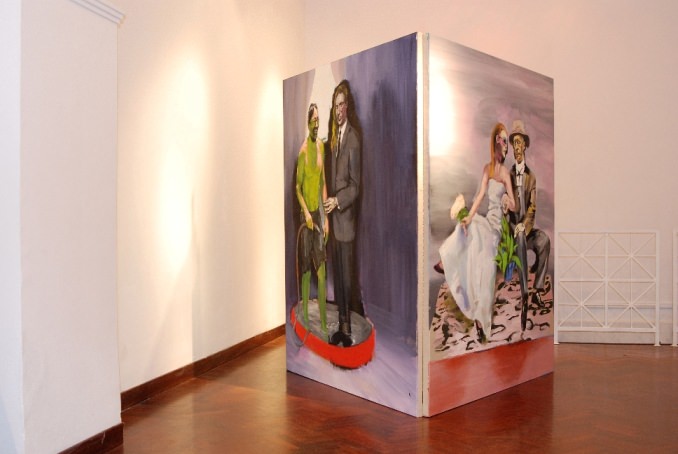
Scarabello indaga il potere attraverso la rappresentazione di chi lo detiene e scandaglia gli effetti dell’esercizio del potere sui volti, sui corpi, sulle posture e sugli atteggiamenti dei protagonisti. I suoi ritratti volutamente lontani da realistici modelli fotografici e frutto invece del libero flusso della fantasia e delle visioni interiori dell’artista, scavano in quello che Scarabello definisce lo stato crudo dell’anima e tendono a rendere allo spettatore un’emozione in grado di evocare il senso di superiorità di chi, ritratto nel dipinto, sembra quasi consapevole del ruolo di rappresentante di una comunità elitaria. Ed è proprio per sottolineare questo aspetto comunitario, questa capacità di non disperdere le energie necessarie per la difesa delle proprie prerogative, che Scarabello ha immaginato di allestire tre grandi tele posizionandole a parallelepipedo, unite da cardini che consentono alla struttura di tenersi eretta, esattamente come legami, convergenze, alleanze sorreggono le élites e consentono ai loro membri di sostenersi l’un l’altro. Così come un ulteriore dipinto si erge al centro della galleria nascondendo la snella struttura lignea che lo sorregge, così introducendo anche un’idea di debolezza contrapposta alle consuete dimostrazioni di forza che il potere abitualmente sfoggia, una debolezza circa la reale sostanza che spesso si nasconde dietro il potere; qui Scarabello rimanda ai Villaggi Potemkin costruiti in cartapesta per impressionare l’imperatrice Caterina II in visita ai territori sottratti all’Impero Ottomano.
Oltre alle grandi tele a dimensione naturale, Scarabello presenta un’installazione che è espressione e conseguenza di un lavoro di catalogazione dei tipi umani che danno carne e vita al potere. Una catalogazione svolta attraverso lo strumento proprio dell’azione dell’artista, che ha dipinto oltre cento piccoli ritratti, raccogliendone e fotografandone una selezione a formare uno slide show che dà corpo all’installazione, in cui due plinti contrapposti fungono l’uno da base d’appoggio per il proiettore, l’altro da protesi corporea dei volti proiettati.
The Gallery Apart is proud to present Uppercrust, Alessandro Scarabello's latest series of paintings and his third solo exhibition at the gallery.
"Upper crust" is an expression used in Anglo-Saxon societies to describe members of the highest social classes, the new aristocracy that exploits its dominant position in economic and financial terms, as well as in communications, in order to influence the masses. The phrase refers to loaves of bread baked in the ovens of the manor houses of the past that were perfectly brown on top (the upper crust) and burnt on the bo! ttom. The top was set aside for the master of the house, while the bottom was designated to the servants. Through this expression, Scarabello continues his examination into humanity, looking at the protest movements that spread across the world over the past few years of the economic crisis and the renewed awareness of that 99% of the world population that has to bow down daily to the rules, the power and the interests of the remaining 1% of humanity. And it is this 1% that becomes the subject of his research. Thus, Scarabello gives life to the Uppercrust series, twelve large paintings, four of which are on exhibit in the gallery. They are life-size portraits of women and men, through whom the artist conveys the presumptuous confidence of belonging to an elite that looks down on the rest of the world from high above - and which the rest of the world looks up at with envy and contempt, but also with an ill-concealed desire of sharing its status.
Scarabello examin! es power through the portrayal of those who hold it and looks at the e ffects that the execution of power has on the protagonists' faces, bodies, postures and attitudes. His portraits, intentionally far from the true-to-life photographic models and the result of a free flowing expression of the artist's imagination and own unique inner vision, delve into what Scarabello defines as the raw naked soul. They also aim to convey to the beholder a feeling that evokes the sense of superiority of those who are portrayed and who appear aware of their roles as representatives of an elite community. And precisely in order to highlight this community aspect, this ability to not waste energy in the defense of individual privileges, Scarabello chose to position three large standing paintings in a triangular formation, hinged together on their sides allowing the structure to stay upright - exactly like the relationships, bonds and alliances that prop up the elites and allow their members to support each other. Similarly, a fourth painting appears free-standin! g in the middle of the space, yet it conceals a slender wood structure that sustains it. Thus Scarabello introduces the concept of weakness - a feebleness in substance that often hides behind common displays of power. Here he is inspired by the Potemkin village myth in which hollow facades of towns were constructed in order to impress the Empress Catherine II during her visit to the territories which had been annexed from the Ottoman Empire.
In addition to the large canvases, Scarabello presents an installation that is the expression and result of a catalogue of human beings who give life and breath to the meaning of power. This work of classification was also carried out through painting and is composed of more than one hundred small portraits. After choosing and taking pictures of a selection of the paintings, Scarabello put together a slideshow that gives substance to the installation in which two plinths are positioned one in front of the other, the ! first serving as a base for the projector and the second as a factitio us body for the projected faces.
Alessandro Scarabello
Nato a Roma nel 1979 dove vive e lavora.
MOSTRE PERSONALI
2012 Uppercrust, The Gallery Apart, Roma
2010 nous voulons, The Gallery Apart, Roma
2009 Alessandro Scarabello al Rialtosantambrogio, The Gallery Apart presso Rialtosantambrogio, Roma
INSIDE #3, The Gallery Apart, Roma
2007 Confronti, a cura di Lucrecia Vega Gramunt e Massimo Scaringella, Federculture, Roma
2006 Tre di tre, a cura di Gabriele Tinti, Antica Fornace Laterizi, Serra de Conti, (AN)
2005 Lifeinlines, a cura di Emanuela Nobile Mino, The Gallery Apart presso Sala 1, Roma
2002 Strutture metropolitane, a cura di Massimo Scaringella, Le Pain Quotidien, Roma
MOSTRE COLLETTIVE
2012 Centro Periferia, Federculture, mostra dei vincitori, Palazzo delle Esposizioni, Roma
Premio Combat Prize 2012, mostra degli artisti finalisti, Museo Civico G. Fattori ex Granai di Villa Mimbelli, Livorno
2011 Garagezero, a cura di/curated by F. Campagna, L. Canova, S. Lux, D. Maestosi, M. Pacella, N. Zanella
2010 Slaves, a cura di/curated by Lori Adragna per NUfactory, @ Palladium Università Roma Tre
6ª Biennale di Tunisi, Palais Kheireddine, Tunisi
Impresa pittura, a cura di Raffaele Gavarro e Claudio libero Pisano, CIAC - Centro internazionale d’arte contemporanea, Genazzano (RM)
Summery 2010, The Gallery Apart, Roma
2009 Nuove Creatività nel Mondo, I vincitori di "Centro-Periferia" Concorso Internazionale Federculture per Giovani Artisti, a cura di Gabriele Simongini, Lucrecia Vega Gramunt e Massimo Scaringella, Camera dei deputati, Roma
Studiovisit - A review on works by young artists, Academy of Fine Arts and Design, Bratislava Slovakia
Summery 2009, The Gallery Apart, Roma
Aftermath, 25a Biennale di Alessandria D'egitto, Egyptian Ministry of Culture Sector of Fine Arts, Cairo, Egitto
2008 Collettiva, The Gallery Apart, Roma
Streams of consciousness – sei artisti contemporanei, a cura di Cecilia Casorati, Palazzo Grassi, Chioggia
Collezione Farnesina Experimenta, a cura di Maurizio Calvesi, Lorenzo Canova, Marco Meneguzzo e Marisa Vescovo, Ministero degli Affari Esteri, Roma
Studiovisit – A review on works by Italian artists, a cura di 26cc, 91mq art project space, Berlino
UP-ART, The Gallery Apart, Roma
2007 Nuovi pittori della realtà, a cura di Maurizio Sciaccaluga, Milano, P.a.c Padiglione d’arte Contemporanea
58° Edizione del Premio Michetti “Nuovi realismi”, a cura di Maurizio Sciaccaluga, Francavilla al Mare (CH)
Spazi aperti 5, Accademia di Romania, Roma
2006 Futuro/Presente - Nuove Creatività, Federculture, Roma
2004 Architetture, a cura di Alessandro Riva, Libreria FMR – Franco Maria Ricci, Milano
2003 Giovane figurazione, a cura di Maurizio Sciaccaluga, Palazzo della Permanente, Milano
2002 L’aldilà nel mondo islamico e occidentale, a cura di Massimo Scaringella, Castello Rosso di Tripoli, Libia
Festa (1), a cura di Massimo Scaringella, Le Pain Quotidien, Roma
2001 Visione intima, Linee della figurazione contemporanea, a cura di Massimo Scaringella, Biblioteca Nazionale di Tripoli, Libia
The Gallery Apart è orgogliosa di presentare Uppercrust, l'ultimo ciclo pittorico di Alessandro Scarabello, alla sua terza personale in galleria.
Uppercrust è l’espressione con cui nelle società anglosassoni vengono indicati gli appartenenti alle leading classes, la nuova aristocrazia che utilizza la propria posizione dominante in termini economici, finanziari, di comunicazione e quant’altro per influenzare le masse. L’espressione richiama le forme di pane che un tempo venivano cotte nelle cucine delle dimore nobiliari e che inevitabilmente presentavano un livello di cottura perfetto nella parte alta (uppercrust, appunto), destinata ai padroni, mentre la parte sottostante bruciata serviva a sfamare la servitù. Scarabello prosegue quindi la sua indagine sull’umanità, prende spunto dai movimenti di protesta diffusisi nel mondo durante questi anni di crisi e dalla rinnovata consapevolezza di chi fa parte di quel 99 per cento di persone che quotidianamente devono piegarsi alle regole, al potere e agli interessi del restante 1 per cento dell’umanità. Ed è proprio questo 1 per cento che diventa oggetto della sua ricerca. Scarabello crea così la serie Uppercrust, dodici grandi tele di cui quattro vengono esposte nella mostra in galleria. Sono ritratti di donne e uomini dipinti a grandezza naturale, di cui l’artista ci rende tutta l’altezzosa consapevolezza di appartenere ad una élite che può guardare il mondo dall’alto verso il basso e a cui il resto dell’umanità guarda con invidia e disprezzo ma anche con malcelata voglia di condivisione.
Scarabello indaga il potere attraverso la rappresentazione di chi lo detiene e scandaglia gli effetti dell’esercizio del potere sui volti, sui corpi, sulle posture e sugli atteggiamenti dei protagonisti. I suoi ritratti volutamente lontani da realistici modelli fotografici e frutto invece del libero flusso della fantasia e delle visioni interiori dell’artista, scavano in quello che Scarabello definisce lo stato crudo dell’anima e tendono a rendere allo spettatore un’emozione in grado di evocare il senso di superiorità di chi, ritratto nel dipinto, sembra quasi consapevole del ruolo di rappresentante di una comunità elitaria. Ed è proprio per sottolineare questo aspetto comunitario, questa capacità di non disperdere le energie necessarie per la difesa delle proprie prerogative, che Scarabello ha immaginato di allestire tre grandi tele posizionandole a parallelepipedo, unite da cardini che consentono alla struttura di tenersi eretta, esattamente come legami, convergenze, alleanze sorreggono le élites e consentono ai loro membri di sostenersi l’un l’altro. Così come un ulteriore dipinto si erge al centro della galleria nascondendo la snella struttura lignea che lo sorregge, così introducendo anche un’idea di debolezza contrapposta alle consuete dimostrazioni di forza che il potere abitualmente sfoggia, una debolezza circa la reale sostanza che spesso si nasconde dietro il potere; qui Scarabello rimanda ai Villaggi Potemkin costruiti in cartapesta per impressionare l’imperatrice Caterina II in visita ai territori sottratti all’Impero Ottomano.
Oltre alle grandi tele a dimensione naturale, Scarabello presenta un’installazione che è espressione e conseguenza di un lavoro di catalogazione dei tipi umani che danno carne e vita al potere. Una catalogazione svolta attraverso lo strumento proprio dell’azione dell’artista, che ha dipinto oltre cento piccoli ritratti, raccogliendone e fotografandone una selezione a formare uno slide show che dà corpo all’installazione, in cui due plinti contrapposti fungono l’uno da base d’appoggio per il proiettore, l’altro da protesi corporea dei volti proiettati.
The Gallery Apart is proud to present Uppercrust, Alessandro Scarabello's latest series of paintings and his third solo exhibition at the gallery.
"Upper crust" is an expression used in Anglo-Saxon societies to describe members of the highest social classes, the new aristocracy that exploits its dominant position in economic and financial terms, as well as in communications, in order to influence the masses. The phrase refers to loaves of bread baked in the ovens of the manor houses of the past that were perfectly brown on top (the upper crust) and burnt on the bo! ttom. The top was set aside for the master of the house, while the bottom was designated to the servants. Through this expression, Scarabello continues his examination into humanity, looking at the protest movements that spread across the world over the past few years of the economic crisis and the renewed awareness of that 99% of the world population that has to bow down daily to the rules, the power and the interests of the remaining 1% of humanity. And it is this 1% that becomes the subject of his research. Thus, Scarabello gives life to the Uppercrust series, twelve large paintings, four of which are on exhibit in the gallery. They are life-size portraits of women and men, through whom the artist conveys the presumptuous confidence of belonging to an elite that looks down on the rest of the world from high above - and which the rest of the world looks up at with envy and contempt, but also with an ill-concealed desire of sharing its status.
Scarabello examin! es power through the portrayal of those who hold it and looks at the e ffects that the execution of power has on the protagonists' faces, bodies, postures and attitudes. His portraits, intentionally far from the true-to-life photographic models and the result of a free flowing expression of the artist's imagination and own unique inner vision, delve into what Scarabello defines as the raw naked soul. They also aim to convey to the beholder a feeling that evokes the sense of superiority of those who are portrayed and who appear aware of their roles as representatives of an elite community. And precisely in order to highlight this community aspect, this ability to not waste energy in the defense of individual privileges, Scarabello chose to position three large standing paintings in a triangular formation, hinged together on their sides allowing the structure to stay upright - exactly like the relationships, bonds and alliances that prop up the elites and allow their members to support each other. Similarly, a fourth painting appears free-standin! g in the middle of the space, yet it conceals a slender wood structure that sustains it. Thus Scarabello introduces the concept of weakness - a feebleness in substance that often hides behind common displays of power. Here he is inspired by the Potemkin village myth in which hollow facades of towns were constructed in order to impress the Empress Catherine II during her visit to the territories which had been annexed from the Ottoman Empire.
In addition to the large canvases, Scarabello presents an installation that is the expression and result of a catalogue of human beings who give life and breath to the meaning of power. This work of classification was also carried out through painting and is composed of more than one hundred small portraits. After choosing and taking pictures of a selection of the paintings, Scarabello put together a slideshow that gives substance to the installation in which two plinths are positioned one in front of the other, the ! first serving as a base for the projector and the second as a factitio us body for the projected faces.
Alessandro Scarabello
Nato a Roma nel 1979 dove vive e lavora.
MOSTRE PERSONALI
2012 Uppercrust, The Gallery Apart, Roma
2010 nous voulons, The Gallery Apart, Roma
2009 Alessandro Scarabello al Rialtosantambrogio, The Gallery Apart presso Rialtosantambrogio, Roma
INSIDE #3, The Gallery Apart, Roma
2007 Confronti, a cura di Lucrecia Vega Gramunt e Massimo Scaringella, Federculture, Roma
2006 Tre di tre, a cura di Gabriele Tinti, Antica Fornace Laterizi, Serra de Conti, (AN)
2005 Lifeinlines, a cura di Emanuela Nobile Mino, The Gallery Apart presso Sala 1, Roma
2002 Strutture metropolitane, a cura di Massimo Scaringella, Le Pain Quotidien, Roma
MOSTRE COLLETTIVE
2012 Centro Periferia, Federculture, mostra dei vincitori, Palazzo delle Esposizioni, Roma
Premio Combat Prize 2012, mostra degli artisti finalisti, Museo Civico G. Fattori ex Granai di Villa Mimbelli, Livorno
2011 Garagezero, a cura di/curated by F. Campagna, L. Canova, S. Lux, D. Maestosi, M. Pacella, N. Zanella
2010 Slaves, a cura di/curated by Lori Adragna per NUfactory, @ Palladium Università Roma Tre
6ª Biennale di Tunisi, Palais Kheireddine, Tunisi
Impresa pittura, a cura di Raffaele Gavarro e Claudio libero Pisano, CIAC - Centro internazionale d’arte contemporanea, Genazzano (RM)
Summery 2010, The Gallery Apart, Roma
2009 Nuove Creatività nel Mondo, I vincitori di "Centro-Periferia" Concorso Internazionale Federculture per Giovani Artisti, a cura di Gabriele Simongini, Lucrecia Vega Gramunt e Massimo Scaringella, Camera dei deputati, Roma
Studiovisit - A review on works by young artists, Academy of Fine Arts and Design, Bratislava Slovakia
Summery 2009, The Gallery Apart, Roma
Aftermath, 25a Biennale di Alessandria D'egitto, Egyptian Ministry of Culture Sector of Fine Arts, Cairo, Egitto
2008 Collettiva, The Gallery Apart, Roma
Streams of consciousness – sei artisti contemporanei, a cura di Cecilia Casorati, Palazzo Grassi, Chioggia
Collezione Farnesina Experimenta, a cura di Maurizio Calvesi, Lorenzo Canova, Marco Meneguzzo e Marisa Vescovo, Ministero degli Affari Esteri, Roma
Studiovisit – A review on works by Italian artists, a cura di 26cc, 91mq art project space, Berlino
UP-ART, The Gallery Apart, Roma
2007 Nuovi pittori della realtà, a cura di Maurizio Sciaccaluga, Milano, P.a.c Padiglione d’arte Contemporanea
58° Edizione del Premio Michetti “Nuovi realismi”, a cura di Maurizio Sciaccaluga, Francavilla al Mare (CH)
Spazi aperti 5, Accademia di Romania, Roma
2006 Futuro/Presente - Nuove Creatività, Federculture, Roma
2004 Architetture, a cura di Alessandro Riva, Libreria FMR – Franco Maria Ricci, Milano
2003 Giovane figurazione, a cura di Maurizio Sciaccaluga, Palazzo della Permanente, Milano
2002 L’aldilà nel mondo islamico e occidentale, a cura di Massimo Scaringella, Castello Rosso di Tripoli, Libia
Festa (1), a cura di Massimo Scaringella, Le Pain Quotidien, Roma
2001 Visione intima, Linee della figurazione contemporanea, a cura di Massimo Scaringella, Biblioteca Nazionale di Tripoli, Libia
06
dicembre 2012
Alessandro Scarabello – Uppercrust
Dal 06 dicembre 2012 al 09 febbraio 2013
arte contemporanea
Location
THE GALLERY APART
Roma, Via Francesco Negri, 43, (Roma)
Roma, Via Francesco Negri, 43, (Roma)
Orario di apertura
martedì - sabato ore 13-19
Vernissage
6 Dicembre 2012, ore 18.30
Autore