Create an account
Welcome! Register for an account
La password verrà inviata via email.
Recupero della password
Recupera la tua password
La password verrà inviata via email.

-
- container colonna1
- Categorie
- #iorestoacasa
- Agenda
- Archeologia
- Architettura
- Arte antica
- Arte contemporanea
- Arte moderna
- Arti performative
- Attualità
- Bandi e concorsi
- Beni culturali
- Cinema
- Contest
- Danza
- Design
- Diritto
- Eventi
- Fiere e manifestazioni
- Film e serie tv
- Formazione
- Fotografia
- Libri ed editoria
- Mercato
- MIC Ministero della Cultura
- Moda
- Musei
- Musica
- Opening
- Personaggi
- Politica e opinioni
- Street Art
- Teatro
- Viaggi
- Categorie
- container colonna2
- Servizi
- Sezioni
- container colonna1



Luca Trevisani – The Truth Is That The Truth Changes
“La mostra è una sinfonia, orchestrata da presenze bi e tridimensionali, che trova il suo climax in un film, che si chiamerà Vodorosli. Le alghe marine ghiacciate, in russo si dicono vodorosli”. Luca Trevisani
Comunicato stampa
Segnala l'evento
Pinksummer: Molto tempo fa, almeno ci sembra molto tempo fa, in occasione della tua prima personale da pinksummer, a proposito di "Clinamen", così chiamasti quel video bellissimo, ci facesti provare a dissertare di equilibrio e di equilibri, muovendo dalla declinazione logico-razionale, fortemente aporetica, che Democrito aveva introdotto per giustificare l'origine aggregativa del suo mondo atomico (atomistico?). Un concetto che di fatto faceva acqua da tutte le parti, e a pagarne le conseguenze fu la sensibilità di Lucrezio, che, incappando in un filtro d'amore, proprio mentre stava intessendo il De Rerum Natura, un elogio poetico alla cosmologia democritea, diventò folle e si tolse la vita.
La tua predilezione ben riposta ci fece raggiungere Francesco Lo Savio, il quale di clinamen non parlò mai, ma sicuramente tentò di proteggersi in una declinazione razionale della vita, finendo addirittura per suicidarsi in un oggetto architettonico razionalista di Le Courbusier.
Nel 2006 si tenne quella tua personale, davvero molto tempo fa, considerando l'obsolescenza dei tempi, se ci pensi allora si poteva ancora parlare, imitando la prosopopea baumaniana un po' modaiola, di società liquida, di provvisorietà nei rapporti sociali, di flessibilità rispetto al lavoro, perché i subprime, anche se si avvertiva che erano già entrati nel nostro orizzonte, nessuno ancora li aveva visti. Tu, allora, e per età e per spirito del tempo, avevi più dimestichezza con l'estetica slide e, a ben pensarci, avresti potuto prendere il tuo skate per scivolare via almeno da queste nostre ulteriori curiosità, ci poteva stare, ma in fondo quella tua mostra di slide non aveva proprio nulla e quindi ci risiamo, dopo tre anni giusti giusti.
Truth is that the truth changes (la verità è che la verità cambia), è l'aforisma che hai scelto per la tua seconda personale da pinksummer, non certamente la tua seconda personale in assoluto essendo che il tuo curriculum si è addensato parecchio nel frattempo. Un titolo che enuncia l'eraclitismo latente (nemmeno troppo latente) della tua ricerca, eppure quello che ci sembra di amare di più nel tuo lavoro è proprio quel lasciare intravedere la tensione verso una verità ultima, che scappi dal divenire del tempo e dal relativismo stesso dell'individualità scissa e conflittuale che di quel tempo, di necessità, non può che scorgere un segmento.
La lotta contro il disequilibrio delle cose e degli esseri che porti avanti tende ad asciugare l'umidità endogena alla pluralità, ma non ti riesce mai. L'equilibrio formale che trovi per approssimazione, anche nelle fasi che preferiamo del tuo lavoro, quelle implosive, risucchianti in un punto ordinato, è sempre perfettibile, foriero di instabilità, non trova la fermezza definitiva dell'essere, la sua profonda e esclusiva assennatezza.
A volte si dovrebbe credere a una tua ammissione aprioristica di fallimento, a un'inutile fatica di Sisifo, oppure, si potrebbe ipotizzare che tu creda che possa esistere un qualche luogo, dentro o fuori dalla mente, in cui le essenze riescano a trovare una quiete appropriata, a cui ambisci, nascondendo dietro alla sobrietà formale che ti contraddistingue ogni frustrazione. Pensiamo che l'idea di equilibrio nel tuo percorso assuma le stesse connotazioni di verità: è possibile che essa diventi per qualche strana alchimia un suo sinonimo oggettivo dentro al tuo sceverare?
Luca Trevisani: Si, è vero. La verità è come l'equilibrio, mutevole e viva, difficile, instabile. Noi siamo vivi e ci ridefiniamo di continuo: anche un corpo morto non è mai uguale a se stesso. Io, me, il cosiddetto consorzio sociale, la legge morale dentro di me, e il cielo stellato sopra di noi. Le stelle non sono mai sempre allo stesso posto. Come minimo quello che vediamo nel cielo è successo circa otto minuti fa ...
Niente è stabile, noi cambiamo e la verità con noi: Veritas filia temporis.
Così vanno le cose, così devo andare, cantavano anni fa. Non ci si può bagnare due volte nello stesso fiume, né prevedere i cambiamenti di costume. Ladies and gentlemen we are floating in space. Per questo il molle vince sul rigido, la cera sul marmo (aveva ragione Medardo) e l'edera sul cemento.
Non so se si tratti di lotta con il disequilibrio, ma forse di stadi di definizione. Di certo la salvezza non è nella forma chiusa delle cose. Dobbiamo arrenderci al logorio delle cose. È meglio dimenticarsi i confini tra le singole opere, come i confini tra i singoli pensieri, non esistono più immagini, ma solo catene di immagini. Un ritmo, una canzone.
Se devo definire il mio lavoro al momento, le convinzioni che lo guidano, e che definiscono la mostra da pinksummer, parlerei di coltivazione.
Mi spiego.
Dico coltivare partendo dal Candide di Voltaire, che si conclude con questa frase: "Il faut cultiver notre jardin", dobbiamo coltivare il nostro giardino.
In uno spazio stabile, definitivo, marmoreo, non c'è bisogno di coltivare. Noi, invece, siamo chiamati a coltivare, a prenderci cura.
Il mondo delle pluralità pian piano prende forma solo grazie al potere del nostro agire.
Da cosa nasce cosa, diceva Bruno.
Oppure, detto in altro modo, nulla si crea e nulla si distrugge.
Nulla si crea e nulla si distrugge, ma tutto si modifica, incessantemente. Identity is a cloud, e non sappiamo nemmeno domani che tempo farà.
Colorare con dei fumogeni non mi interessa per l'automaticità del gesto, quella la lasciamo ad altri, venuti prima di me. Colorare col fumogeno è come colorare con il vento, se esistono vettori e non forze, allora ha senso dare forza a questi vettori, e colorarli.
P: Tu dici che il molle vince sul rigido, che la cera vince sul marmo, l'edera sul cemento. Forse hai ragione, Luca Cerizza, in un testo scritto per te, ipotizza verosimilmente la fine dell'angolo retto, perché in natura non esistono angoli retti. In Italia, sotto il profilo politico, questa plasticità delle forme un po' estrema (cominciando da quelle asservite delle vallette) si sta già attuando da un pezzo e non ci piace.
Tuttavia, sul fatto che la cera vinca sul marmo rimaniamo un poco perplesse. Giulio Carlo Argan (una nostra amica che insegna storia dell'arte all'università di Genova, ci ha detto che "l'Argan" come manuale non è più in uso perché i ragazzi non lo capiscono, se pensiamo che negli anni '70 Argan fu eletto sindaco di Roma) insegnava che Medardo Rosso e Auguste Rodin erano due grandi scultori, ma che alla fine fu Degas a ristrutturare, tu diresti ridefinire, l'arte plastica, forse perché essendo pittore la utilizzava semplicemente come una sorta di laboratorio di analisi, senza enfasi. Rodin e Rosso pensavano invece alla dignità letteraria della materia e, se uno era ossessionato dall'idea di monumento, l'altro lo era da quella di anti-monumento. La cera era utile a Rosso per visualizzare un processo induttivo che implicava l'apertura di una forma chiusa allo spazio, all'atmosfera, mantenendo nel contempo integro il gusto per l'aneddoto. Riteniamo, sicuramente a torto, che per Michelangiolo marmo o cera sarebbe stato lo stesso, forse la cera avrebbe semplificato le cose considerando che deduceva la forma dentro la materia, limitandosi a eliminare il superfluo. Anche quando l'oppressione della materia si era fatta greve, come nel caso della Pietà Rondanini, Michelangiolo riuscì comunque a rendere percepibile il vettore orientato sull'ascesa.
Rispetto al tuo dipingere con i fumogeni, considerando l'indefinitezza della tela, per noi è più facile immaginare il vento come un vettore piuttosto che come un colore. Il vettore-vento, un segmento (frammento?) orientato, potrebbe allora sussumere il colore dei tuoi fumogeni e in questo senso essere rafforzato, reso percepibile, innanzi tutto alla tua coscienza, in secondo luogo all'altro o magari contemporaneamente. Questo non significa creare un confine? L'idea di confine ci sembra una costante della tua ricerca. Coltivare il proprio giardino, prendersi cura di, non significa delimitare e Voltaire, d'altra parte, non era un lume?
La coltivazione non segna il passaggio dalla società matriarcale nomadica, legata al flusso, alla totalità, a quella patriarcale della cultura, informata sugli angoli retti, sui dogmi, sull'ideale di potenza, quella per intenderci che in epoca più recente ha steso il cemento sull'edera? Il passaggio dalla natura al logos, non certo dal caos al cosmo perché quello avvenne prima e non ci riguarda, non ci ha insegnato che stabilire dei confini, delle proprietà, è utile alla sopravvivenza?
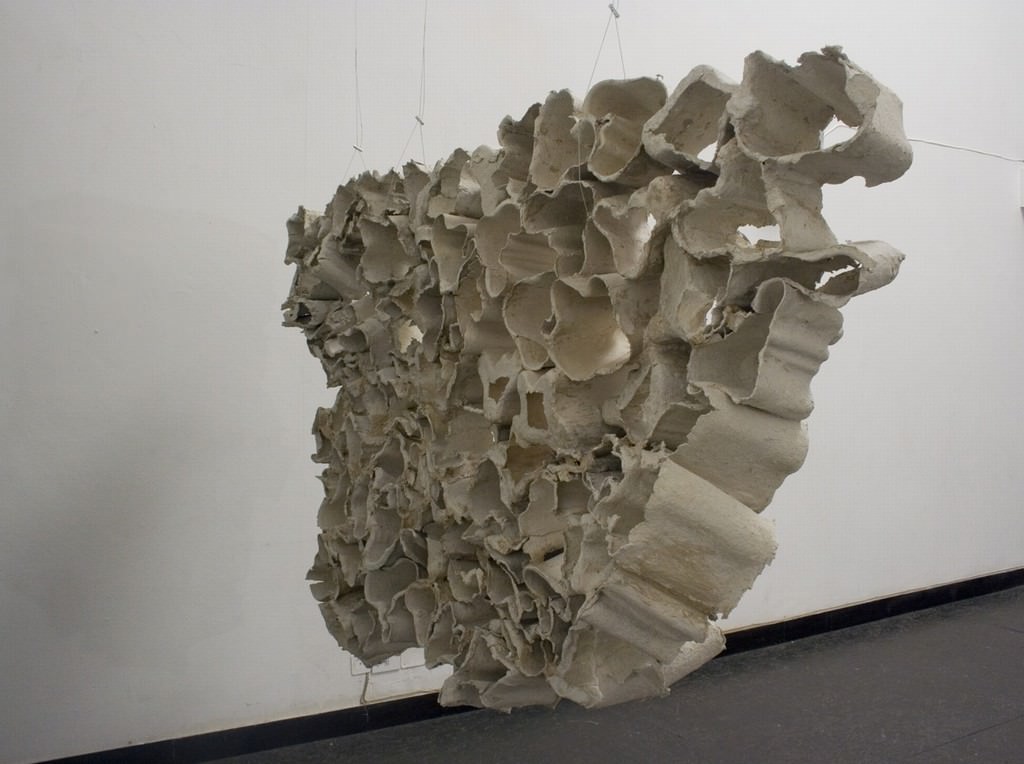
L.T.: Nominavo Medardo un po' per gioco. Mi sento scultore, sì, ma non in quel senso. La storia delle idee mi appassiona più della storia della scultura, quella mi piace saccheggiarla per i miei fini. Per i lavori in mostra ho lavorato con cera e cartapesta, selezionando materiali precari. Mi piace l’idea che si blocchino in delle forme per del tempo, e poi tornino in ciclo. La cera si scioglierà e la cartapesta tornerà a essere qualcosa d’altro. Forse. Prima o poi.
Lo so bene, il vento è un vettore, non un colore, certo. Quello che dico, appunto, è che è interessante dotare di colore un vettore. Valorizzarlo.
Coltivare nel senso di prendersi cura, non conduce per forza al cemento. Non corriamo troppo. I concetti dobbiamo usarli come strumenti, ma non strumentalizzarli. Tutto il mio lavoro si basa sul fornire concetti base, strumenti, leve per muovere le cose, ma se li banalizziamo, se cerchiamo una loro applicazione pratica immediata, tutto si sfalda. Le idee servono per pensare, devono tradursi in azione, sì, ma con calma, devono maturare.
Si tratta di non temere le astrazioni, anche se apparentemente possono sembrare insensate, perché sono un ottimo strumento con cui guardare il mondo.
L’unico modo per capire le cose è farne un modellino da poter tenere in mano, per estraniarle dal quotidiano.
P: Uno sguardo contemplativo è uno sguardo che trova la bellezza senza cercarla?
L.T.: Dall' osservare il volo degli uccelli, questa voce augurale passo al significato più generale di sollevare lo sguardo e il pensiero verso una cosa, che desti meraviglia o riverenza, a cui dare attenzione con atto prolungato e intenso. Rimirare, osservare intensamente. Fissare tanto il pensiero nelle cose divine, che non si curi altro nel mondo, e quelle sole ci siano di consolazione e diletto.
Non parlerei però di bellezza. Affatto.
Un vecchio errore è la ricerca della bellezza. La bellezza non può essere programmata, essendo sempre l' effetto secondario di altre ricerche. Bisogna parlare con le immagini, non con le immagini belle, ma con le immagini utili; non devono servire parole a sorreggerle, devono vivere da sole. Le parole sono la genealogia delle immagini e delle forme, che parlano da sole. Wystan Auden diceva che il modo migliore per ascoltare la messa è quello di non conoscere la lingua in cui viene celebrata.
P: Nei tuoi appunti ci parlasti di butterfly farm, di greenhouse, di energie ateleologiche, del modulo organico di Alvar Aalto, del suo concetto di spazio organico, di ciò che avviene di nascosto sulla spiaggia di Skagen. Cosa porterai da pinksummer? Come articolerai il tuo progetto?
L. T.: La mostra è una sinfonia, orchestrata da presenze bi e tridimensionali, che trova il suo climax in un film, che si chiamerà Vodorosli. Le alghe marine ghiacciate, in russo si dicono vodorosli.
Sono partito da un modulo ereditato da Alvar Aalto, ho riportato il pensiero organico a casa, dentro all' orto botanico di Genova, e l' ho trattato come una pianta.
Le convinzioni di Aalto in uno spazio organico diventano lo spunto per un sistema formale mobile, vivo, costruito e animato dentro scatole trasparenti. Se mi interessa dare forma a un sistema e vedere come si regolamenta, come trova un equilibrio tra le sue parti, lo faccio all' interno di scatole trasparenti, coltivandolo in vitro.
Mi interessava vedere dove il confine e il disegno dell’uomo si impongono sulla natura, e dove le leggi di natura vincono. Sottoporre le forme pure alla corruzione, al dinamismo naturale. Ho ridisegnato dei frangiflutti, colmato il vuoto tra i sassi di un muro a secco, colorato con dei fumogeni, bloccato cotiledoni nella cera…
Si tratta di energie, ma di energie senza utilità. Energie pure. Di stati di indeterminatezza, di definizione, di realtà aperte al flusso, alla propria determinazione tramite il mutamento.
Si ringrazia l'Orto Botanico dell'Università di Genova.
La galleria è aperta dal martedì al sabato, dalle 15.00 alle 19.30.
pinksummer
Palazzo Ducale-Cortile Maggiore
Piazza Matteotti 28r 16123
Genova Italy
t/f +39 010 2543762
www.pinksummer.com
LUCA TREVISANI
Opening May 29th 2009, 6.30 p.m.
The Truth Is That The Truth Changes
Press release as interview
Pinksummer: A long time ago, or at least it seems to us like a long time ago, on the occasion of your first solo exhibition at pinksummer, regarding "Clinamen" - as you called that wonderful video - you made us try dissertating of balance and balances, starting from the logical-rational declination, very aporetic, that Democritus had introduced to justify the associative origin of its atomic world (atomistic?). A concept that, as a matter of fact, leaked from every part, and to pay for this was Lucretius' sensibility, who, running into a love filter, right while he was weaving the De Rerum Natura, a poetic praise to the cosmology of Democritus, became crazy and killed himself.
Your quite put back partiality led us to Francesco Lo Savio, who never spoke of clinamen, but surely tried to protect himself in a rational declension of life, absolutely ending into committing suicide in a rationalist architectural object by Le Courbusier.
That show was in 2006, really a long time ago, considering the obsolescence of times, and, if you think about it, then it was still possible to talk about that, imitating the baumanian prosopopoeia, a little fashionable, of liquid society, of temporariness in the social relations, of flexibility of the work, because subprimes, even if we could already sense that they were entering our horizon, nobody had ever seen them yet. You, back then, both because of your age and for the time, had more familiarity with slide aesthetics and, if we think about it, you could have taken your skate to slide away at least from these further curiosities of ours; it could have been, but at the end that show had nothing to do with sliding, and so here we are again, after exactly three years.
Truth is that the truth changes (la verità è che la verità cambia), is the aphorism you chose for your second solo show at pinksummer, not certainly your second solo exhibition at all since your curriculum has meanwhile increased. It’s a title that formulates the latent heraclitism (not even too latent) of your research, and yet what we seem to love more about your work is that it lets foresee the tension towards a last truth, that would escape from the becoming of time and from the relativism of the split and conflictual individuality that, of that time, by necessity, can only distinguish a segment.
The struggle against the lack of balance of things and of human beings that you carry on, tends to dry the endogenous dampness at plurality, but never succeeds. The formal balance you find for approximation, also in those phases we prefer of your work - those implosives, swallowing in an orderly point - is always perfectible, presaging of instability, it does not find the definitive firmness of being, its deep and exclusive common sense.
Sometimes we should believe it is a a priori admission of failure of yours, an useless toil of Sisyphus, or, we could suppose that you believe there can be some place, inside or outside the mind, in which the essences could find an appropriate quietness you long for, hiding behind the formal sobriety that marks you, every frustration. We think that the idea of balance in your path takes on the same connotations of the truth: is it possible that it becomes, for some weird alchemy, an objective synonym inside your discerning?
Luca Trevisani: Yes, it is true. The truth is like the balance, changeable and alive, difficult, unstable. We are alive and we redefine ourselves continuously: also a dead body is never the same. I, me, the so called social consortium, the moral law inside me, and the starry sky above us. Stars are never in the same place. What we see in the sky happened at least about eight minutes ago...
Nothing is stable, we change and the truth with us: Veritas filia temporis.
So things go, so I must go, they sang years ago. We cannot bath twice in the same river, nor predict changes of costume. Ladies and gentlemen we are floating in space. This is why soft wins over rigid, wax over marble (Medardo was right) and ivy over cement.
I do not know if it is a fight with disequilibrium, perhaps stages of definition. For sure salvation is not in the closed shape of things. We must surrender to the wearing out of things. It is better to forget the boundaries between the single works, as well as the boundaries between the single thoughts, there are no more images, but chains of images. A rhythm, a song.
If I must define my work at the moment, the firm belief that guides it, and that defines the show at pinksummer, I would speak of cultivation.
I explain myself.
I say cultivate thinking of the Candide by Voltaire, that ends with this sentence: "Il faut cultiver notre jardin", we must cultivate our garden.
In a stable, definitive, marmoreal space, there is no need to cultivate. We, on the other hand, are called to cultivate, to take care.
The world of pluralities slowly takes form only through the power of our actions.
From thing comes thing, said Bruno.
Or, in other words, nothing is created and nothing is destroyed.
Nothing is created and nothing is destroyed, but everything changes, constantly. Identity is a cloud, and we do not even know which weather will be tomorrow.
I am not interested in colouring with smoke candles for the automaticity of the gesture, we leave that to others that came before me. Colouring with smoke candles is like colouring with the wind, if there are vectors and not forces, then it makes sense to give power to these vectors, and colour them.
P: You say that soft wins over rigid, wax over marble, ivy over cement. Maybe you are right, Luca Cerizza, in a text he had written for you, verisimilarly assumes the end of the right angle, because in nature there are no right angles. In Italy, under a political profile, this plasticity of the forms a bit extreme (starting from the subjected one of the veline) has been going on for a while, and we do not like it.
Anyway, about the fact that wax wins over marble we are a bit perplex. Giulio Carlo Argan (a friend of ours who teaches history of art at the University of Genoa told us that the Argan as a manual is no longer used because students do not understand it, if we think that in the 70s Argan was elected mayor of Rome) taught that Medardo Rosso and Auguste Rodin were two great sculptors, but at the end was Degas to renovate, you would say redefine, plastic art, perhaps because he, being a painter would use it only as a sort of analysis lab, without emphasis. Rodin and Rosso thought, instead, at the literary dignity of the matter and, if one of them was obsessed by the idea of monument, the other was of the idea of anti-monument. Wax was useful to Rosso to visualize an inductive method that implicated the opening of a closed form in the space, in the atmosphere, at the same time maintaining the taste for the anecdote integral. We believe, surely by mistake, that for Michelangiolo marble or wax would have been the same, maybe wax would have simplified things considering that it would deduce form inside matter, limiting to exclude the unnecessary. Also when the oppression of matter became grievous, as in the case of the Pietà Rondanini, Michelangiolo managed anyway to render the vector upward orientated perceptible.
Regarding your way to paint with smoke candles, considering the indefiniteness of the canvas, it is easier for us to imagine the wind as a vector rather than as a colour. The vector-wind, an oriented segment (fragment?), could then subsume the colour of your smoke candles and in this sense be reinforced, noticeable, first of all to your conscience, in second place to the other or maybe simultaneously. Doesn’t this mean creating a boundary? The idea of boundary seems to us a constant of your research. Cultivating our garden, taking care of, don’t they mean delimitating, and, by the way, wasn’t Voltaire enlightened?
Doesn’t cultivation mark the shift to a nomadic matriarchal society, linked to flow, to totality, to the patriarchal culture, based on right angles, on dogmas, on the ideal power, that, to be precise, that in recent times, laid down cement over ivy? Didn’t the passage from nature to logos, not certainly from chaos to universe because that came first and doesn’t concern us, teach us that fixing boundaries, properties, is useful to survival?
L.T.: I was mentioning Medardo a bit for fun. I feel I am a sculptor, yes, but not in that sense. I’m passionate about the history if ideas more than about the history of sculpture, which I like to raid for my own purposes. For the works that will be on show I have worked with wax and papier-mâché, selecting precarious materials. I like the idea that they get stuck in some shape for some time, and then come back in circle. The wax will melt and the papier-mâché will return to be something else. Maybe. Sooner or later.
I know it well, the wind is a vector, not a colour, of course. What I say, precisely, is that it is interesting to provide a vector with colour. To Exploit it.
Cultivating in the sense of taking care, does not absolutely lead to cement. Let’s not run too much. We must use concepts like instruments, but not manipulate them. All my work is based on giving basic concepts, instruments, levers to move things, but if we banalize them, if we look for an immediate practical application of them, everything flakes. Ideas must be used to think, they must be translated in action, yes, but with calm, they must mature.
It’s about not being afraid of abstractions, even if they apparently might seem senseless, because they are an excellent instrument through which looking at the world.
The only way to understand things is to make a small model that can be hold in hand, to alienate them from the everyday.
P: Is a contemplative gaze a gaze that finds beauty without looking for it?
L. T.: From observing the flight of birds, that augural voice, I turn to the most extensive meaning of raising the gaze and the thought towards something, that would rouse astonishment or reverence, to which giving attention with a prolonged and intense act. Staring at, intensely observing. Fixing the thought on divine things, so that it would not care about anything else in the world, and only those to be of consolation and delight.
I would not talk about beauty though. Not at all.
The research for beauty is an old mistake. Beauty cannot be programmed, as it always is the secondary effect of other researches. We must talk with images, not with beautiful images, but with useful images; they should not need words to support them, they must live alone. Words are the genealogy of images and forms, that speak for themselves. Wystan Auden said that the best way to hear Mass is without knowing the language in which it is celebrated.
P: In your notes you spoke about butterfly farms, about greenhouses, a-teleological energies, the organic module by Alvar Aalto, his concept of organic space, about what hiddenly happens on the beach of Skagen. What will you present at pinksummer? How will you articulate your project?
L. T.: The show is a symphony, orchestrated with bi and tri-dimensional presences, that will find its climax in a movie, that will be called Vodorosli. Frozen seaweeds in Russian are called vodorosli.
I started from a module I have inherited from Alvar Aalto, I have taken the organic thought back home, inside the botanical garden of Genoa, and I treated it like a plant.
Aalto’s belief in an organic space becomes the hint for a mobile, alive formal system, built and animated inside transparent boxes. If I am interested into giving shape to a system and see how it auto regulates itself, how it finds a balance between its parts, I would do it inside transparent boxes, cultivating it in vitro.
I was interested in seeing where the boundaries and drawings by men impose themselves on nature, and where the laws of nature win. Subjecting pure forms to corruption, to natural dynamism. I have drawn again breakwater, filled the void between the stones of a dry-stone wall, coloured with smoke candles, blocked cotyledons inside wax...
It is about energies, but energies without qualities. Pure energies. About stages of vagueness, of definition, of realities opened to the flow, to our own determination through change.
Many thanks to the Botanical Garden of the University of Genoa.
La tua predilezione ben riposta ci fece raggiungere Francesco Lo Savio, il quale di clinamen non parlò mai, ma sicuramente tentò di proteggersi in una declinazione razionale della vita, finendo addirittura per suicidarsi in un oggetto architettonico razionalista di Le Courbusier.
Nel 2006 si tenne quella tua personale, davvero molto tempo fa, considerando l'obsolescenza dei tempi, se ci pensi allora si poteva ancora parlare, imitando la prosopopea baumaniana un po' modaiola, di società liquida, di provvisorietà nei rapporti sociali, di flessibilità rispetto al lavoro, perché i subprime, anche se si avvertiva che erano già entrati nel nostro orizzonte, nessuno ancora li aveva visti. Tu, allora, e per età e per spirito del tempo, avevi più dimestichezza con l'estetica slide e, a ben pensarci, avresti potuto prendere il tuo skate per scivolare via almeno da queste nostre ulteriori curiosità, ci poteva stare, ma in fondo quella tua mostra di slide non aveva proprio nulla e quindi ci risiamo, dopo tre anni giusti giusti.
Truth is that the truth changes (la verità è che la verità cambia), è l'aforisma che hai scelto per la tua seconda personale da pinksummer, non certamente la tua seconda personale in assoluto essendo che il tuo curriculum si è addensato parecchio nel frattempo. Un titolo che enuncia l'eraclitismo latente (nemmeno troppo latente) della tua ricerca, eppure quello che ci sembra di amare di più nel tuo lavoro è proprio quel lasciare intravedere la tensione verso una verità ultima, che scappi dal divenire del tempo e dal relativismo stesso dell'individualità scissa e conflittuale che di quel tempo, di necessità, non può che scorgere un segmento.
La lotta contro il disequilibrio delle cose e degli esseri che porti avanti tende ad asciugare l'umidità endogena alla pluralità, ma non ti riesce mai. L'equilibrio formale che trovi per approssimazione, anche nelle fasi che preferiamo del tuo lavoro, quelle implosive, risucchianti in un punto ordinato, è sempre perfettibile, foriero di instabilità, non trova la fermezza definitiva dell'essere, la sua profonda e esclusiva assennatezza.
A volte si dovrebbe credere a una tua ammissione aprioristica di fallimento, a un'inutile fatica di Sisifo, oppure, si potrebbe ipotizzare che tu creda che possa esistere un qualche luogo, dentro o fuori dalla mente, in cui le essenze riescano a trovare una quiete appropriata, a cui ambisci, nascondendo dietro alla sobrietà formale che ti contraddistingue ogni frustrazione. Pensiamo che l'idea di equilibrio nel tuo percorso assuma le stesse connotazioni di verità: è possibile che essa diventi per qualche strana alchimia un suo sinonimo oggettivo dentro al tuo sceverare?
Luca Trevisani: Si, è vero. La verità è come l'equilibrio, mutevole e viva, difficile, instabile. Noi siamo vivi e ci ridefiniamo di continuo: anche un corpo morto non è mai uguale a se stesso. Io, me, il cosiddetto consorzio sociale, la legge morale dentro di me, e il cielo stellato sopra di noi. Le stelle non sono mai sempre allo stesso posto. Come minimo quello che vediamo nel cielo è successo circa otto minuti fa ...
Niente è stabile, noi cambiamo e la verità con noi: Veritas filia temporis.
Così vanno le cose, così devo andare, cantavano anni fa. Non ci si può bagnare due volte nello stesso fiume, né prevedere i cambiamenti di costume. Ladies and gentlemen we are floating in space. Per questo il molle vince sul rigido, la cera sul marmo (aveva ragione Medardo) e l'edera sul cemento.
Non so se si tratti di lotta con il disequilibrio, ma forse di stadi di definizione. Di certo la salvezza non è nella forma chiusa delle cose. Dobbiamo arrenderci al logorio delle cose. È meglio dimenticarsi i confini tra le singole opere, come i confini tra i singoli pensieri, non esistono più immagini, ma solo catene di immagini. Un ritmo, una canzone.
Se devo definire il mio lavoro al momento, le convinzioni che lo guidano, e che definiscono la mostra da pinksummer, parlerei di coltivazione.
Mi spiego.
Dico coltivare partendo dal Candide di Voltaire, che si conclude con questa frase: "Il faut cultiver notre jardin", dobbiamo coltivare il nostro giardino.
In uno spazio stabile, definitivo, marmoreo, non c'è bisogno di coltivare. Noi, invece, siamo chiamati a coltivare, a prenderci cura.
Il mondo delle pluralità pian piano prende forma solo grazie al potere del nostro agire.
Da cosa nasce cosa, diceva Bruno.
Oppure, detto in altro modo, nulla si crea e nulla si distrugge.
Nulla si crea e nulla si distrugge, ma tutto si modifica, incessantemente. Identity is a cloud, e non sappiamo nemmeno domani che tempo farà.
Colorare con dei fumogeni non mi interessa per l'automaticità del gesto, quella la lasciamo ad altri, venuti prima di me. Colorare col fumogeno è come colorare con il vento, se esistono vettori e non forze, allora ha senso dare forza a questi vettori, e colorarli.
P: Tu dici che il molle vince sul rigido, che la cera vince sul marmo, l'edera sul cemento. Forse hai ragione, Luca Cerizza, in un testo scritto per te, ipotizza verosimilmente la fine dell'angolo retto, perché in natura non esistono angoli retti. In Italia, sotto il profilo politico, questa plasticità delle forme un po' estrema (cominciando da quelle asservite delle vallette) si sta già attuando da un pezzo e non ci piace.
Tuttavia, sul fatto che la cera vinca sul marmo rimaniamo un poco perplesse. Giulio Carlo Argan (una nostra amica che insegna storia dell'arte all'università di Genova, ci ha detto che "l'Argan" come manuale non è più in uso perché i ragazzi non lo capiscono, se pensiamo che negli anni '70 Argan fu eletto sindaco di Roma) insegnava che Medardo Rosso e Auguste Rodin erano due grandi scultori, ma che alla fine fu Degas a ristrutturare, tu diresti ridefinire, l'arte plastica, forse perché essendo pittore la utilizzava semplicemente come una sorta di laboratorio di analisi, senza enfasi. Rodin e Rosso pensavano invece alla dignità letteraria della materia e, se uno era ossessionato dall'idea di monumento, l'altro lo era da quella di anti-monumento. La cera era utile a Rosso per visualizzare un processo induttivo che implicava l'apertura di una forma chiusa allo spazio, all'atmosfera, mantenendo nel contempo integro il gusto per l'aneddoto. Riteniamo, sicuramente a torto, che per Michelangiolo marmo o cera sarebbe stato lo stesso, forse la cera avrebbe semplificato le cose considerando che deduceva la forma dentro la materia, limitandosi a eliminare il superfluo. Anche quando l'oppressione della materia si era fatta greve, come nel caso della Pietà Rondanini, Michelangiolo riuscì comunque a rendere percepibile il vettore orientato sull'ascesa.
Rispetto al tuo dipingere con i fumogeni, considerando l'indefinitezza della tela, per noi è più facile immaginare il vento come un vettore piuttosto che come un colore. Il vettore-vento, un segmento (frammento?) orientato, potrebbe allora sussumere il colore dei tuoi fumogeni e in questo senso essere rafforzato, reso percepibile, innanzi tutto alla tua coscienza, in secondo luogo all'altro o magari contemporaneamente. Questo non significa creare un confine? L'idea di confine ci sembra una costante della tua ricerca. Coltivare il proprio giardino, prendersi cura di, non significa delimitare e Voltaire, d'altra parte, non era un lume?
La coltivazione non segna il passaggio dalla società matriarcale nomadica, legata al flusso, alla totalità, a quella patriarcale della cultura, informata sugli angoli retti, sui dogmi, sull'ideale di potenza, quella per intenderci che in epoca più recente ha steso il cemento sull'edera? Il passaggio dalla natura al logos, non certo dal caos al cosmo perché quello avvenne prima e non ci riguarda, non ci ha insegnato che stabilire dei confini, delle proprietà, è utile alla sopravvivenza?
L.T.: Nominavo Medardo un po' per gioco. Mi sento scultore, sì, ma non in quel senso. La storia delle idee mi appassiona più della storia della scultura, quella mi piace saccheggiarla per i miei fini. Per i lavori in mostra ho lavorato con cera e cartapesta, selezionando materiali precari. Mi piace l’idea che si blocchino in delle forme per del tempo, e poi tornino in ciclo. La cera si scioglierà e la cartapesta tornerà a essere qualcosa d’altro. Forse. Prima o poi.
Lo so bene, il vento è un vettore, non un colore, certo. Quello che dico, appunto, è che è interessante dotare di colore un vettore. Valorizzarlo.
Coltivare nel senso di prendersi cura, non conduce per forza al cemento. Non corriamo troppo. I concetti dobbiamo usarli come strumenti, ma non strumentalizzarli. Tutto il mio lavoro si basa sul fornire concetti base, strumenti, leve per muovere le cose, ma se li banalizziamo, se cerchiamo una loro applicazione pratica immediata, tutto si sfalda. Le idee servono per pensare, devono tradursi in azione, sì, ma con calma, devono maturare.
Si tratta di non temere le astrazioni, anche se apparentemente possono sembrare insensate, perché sono un ottimo strumento con cui guardare il mondo.
L’unico modo per capire le cose è farne un modellino da poter tenere in mano, per estraniarle dal quotidiano.
P: Uno sguardo contemplativo è uno sguardo che trova la bellezza senza cercarla?
L.T.: Dall' osservare il volo degli uccelli, questa voce augurale passo al significato più generale di sollevare lo sguardo e il pensiero verso una cosa, che desti meraviglia o riverenza, a cui dare attenzione con atto prolungato e intenso. Rimirare, osservare intensamente. Fissare tanto il pensiero nelle cose divine, che non si curi altro nel mondo, e quelle sole ci siano di consolazione e diletto.
Non parlerei però di bellezza. Affatto.
Un vecchio errore è la ricerca della bellezza. La bellezza non può essere programmata, essendo sempre l' effetto secondario di altre ricerche. Bisogna parlare con le immagini, non con le immagini belle, ma con le immagini utili; non devono servire parole a sorreggerle, devono vivere da sole. Le parole sono la genealogia delle immagini e delle forme, che parlano da sole. Wystan Auden diceva che il modo migliore per ascoltare la messa è quello di non conoscere la lingua in cui viene celebrata.
P: Nei tuoi appunti ci parlasti di butterfly farm, di greenhouse, di energie ateleologiche, del modulo organico di Alvar Aalto, del suo concetto di spazio organico, di ciò che avviene di nascosto sulla spiaggia di Skagen. Cosa porterai da pinksummer? Come articolerai il tuo progetto?
L. T.: La mostra è una sinfonia, orchestrata da presenze bi e tridimensionali, che trova il suo climax in un film, che si chiamerà Vodorosli. Le alghe marine ghiacciate, in russo si dicono vodorosli.
Sono partito da un modulo ereditato da Alvar Aalto, ho riportato il pensiero organico a casa, dentro all' orto botanico di Genova, e l' ho trattato come una pianta.
Le convinzioni di Aalto in uno spazio organico diventano lo spunto per un sistema formale mobile, vivo, costruito e animato dentro scatole trasparenti. Se mi interessa dare forma a un sistema e vedere come si regolamenta, come trova un equilibrio tra le sue parti, lo faccio all' interno di scatole trasparenti, coltivandolo in vitro.
Mi interessava vedere dove il confine e il disegno dell’uomo si impongono sulla natura, e dove le leggi di natura vincono. Sottoporre le forme pure alla corruzione, al dinamismo naturale. Ho ridisegnato dei frangiflutti, colmato il vuoto tra i sassi di un muro a secco, colorato con dei fumogeni, bloccato cotiledoni nella cera…
Si tratta di energie, ma di energie senza utilità. Energie pure. Di stati di indeterminatezza, di definizione, di realtà aperte al flusso, alla propria determinazione tramite il mutamento.
Si ringrazia l'Orto Botanico dell'Università di Genova.
La galleria è aperta dal martedì al sabato, dalle 15.00 alle 19.30.
pinksummer
Palazzo Ducale-Cortile Maggiore
Piazza Matteotti 28r 16123
Genova Italy
t/f +39 010 2543762
www.pinksummer.com
LUCA TREVISANI
Opening May 29th 2009, 6.30 p.m.
The Truth Is That The Truth Changes
Press release as interview
Pinksummer: A long time ago, or at least it seems to us like a long time ago, on the occasion of your first solo exhibition at pinksummer, regarding "Clinamen" - as you called that wonderful video - you made us try dissertating of balance and balances, starting from the logical-rational declination, very aporetic, that Democritus had introduced to justify the associative origin of its atomic world (atomistic?). A concept that, as a matter of fact, leaked from every part, and to pay for this was Lucretius' sensibility, who, running into a love filter, right while he was weaving the De Rerum Natura, a poetic praise to the cosmology of Democritus, became crazy and killed himself.
Your quite put back partiality led us to Francesco Lo Savio, who never spoke of clinamen, but surely tried to protect himself in a rational declension of life, absolutely ending into committing suicide in a rationalist architectural object by Le Courbusier.
That show was in 2006, really a long time ago, considering the obsolescence of times, and, if you think about it, then it was still possible to talk about that, imitating the baumanian prosopopoeia, a little fashionable, of liquid society, of temporariness in the social relations, of flexibility of the work, because subprimes, even if we could already sense that they were entering our horizon, nobody had ever seen them yet. You, back then, both because of your age and for the time, had more familiarity with slide aesthetics and, if we think about it, you could have taken your skate to slide away at least from these further curiosities of ours; it could have been, but at the end that show had nothing to do with sliding, and so here we are again, after exactly three years.
Truth is that the truth changes (la verità è che la verità cambia), is the aphorism you chose for your second solo show at pinksummer, not certainly your second solo exhibition at all since your curriculum has meanwhile increased. It’s a title that formulates the latent heraclitism (not even too latent) of your research, and yet what we seem to love more about your work is that it lets foresee the tension towards a last truth, that would escape from the becoming of time and from the relativism of the split and conflictual individuality that, of that time, by necessity, can only distinguish a segment.
The struggle against the lack of balance of things and of human beings that you carry on, tends to dry the endogenous dampness at plurality, but never succeeds. The formal balance you find for approximation, also in those phases we prefer of your work - those implosives, swallowing in an orderly point - is always perfectible, presaging of instability, it does not find the definitive firmness of being, its deep and exclusive common sense.
Sometimes we should believe it is a a priori admission of failure of yours, an useless toil of Sisyphus, or, we could suppose that you believe there can be some place, inside or outside the mind, in which the essences could find an appropriate quietness you long for, hiding behind the formal sobriety that marks you, every frustration. We think that the idea of balance in your path takes on the same connotations of the truth: is it possible that it becomes, for some weird alchemy, an objective synonym inside your discerning?
Luca Trevisani: Yes, it is true. The truth is like the balance, changeable and alive, difficult, unstable. We are alive and we redefine ourselves continuously: also a dead body is never the same. I, me, the so called social consortium, the moral law inside me, and the starry sky above us. Stars are never in the same place. What we see in the sky happened at least about eight minutes ago...
Nothing is stable, we change and the truth with us: Veritas filia temporis.
So things go, so I must go, they sang years ago. We cannot bath twice in the same river, nor predict changes of costume. Ladies and gentlemen we are floating in space. This is why soft wins over rigid, wax over marble (Medardo was right) and ivy over cement.
I do not know if it is a fight with disequilibrium, perhaps stages of definition. For sure salvation is not in the closed shape of things. We must surrender to the wearing out of things. It is better to forget the boundaries between the single works, as well as the boundaries between the single thoughts, there are no more images, but chains of images. A rhythm, a song.
If I must define my work at the moment, the firm belief that guides it, and that defines the show at pinksummer, I would speak of cultivation.
I explain myself.
I say cultivate thinking of the Candide by Voltaire, that ends with this sentence: "Il faut cultiver notre jardin", we must cultivate our garden.
In a stable, definitive, marmoreal space, there is no need to cultivate. We, on the other hand, are called to cultivate, to take care.
The world of pluralities slowly takes form only through the power of our actions.
From thing comes thing, said Bruno.
Or, in other words, nothing is created and nothing is destroyed.
Nothing is created and nothing is destroyed, but everything changes, constantly. Identity is a cloud, and we do not even know which weather will be tomorrow.
I am not interested in colouring with smoke candles for the automaticity of the gesture, we leave that to others that came before me. Colouring with smoke candles is like colouring with the wind, if there are vectors and not forces, then it makes sense to give power to these vectors, and colour them.
P: You say that soft wins over rigid, wax over marble, ivy over cement. Maybe you are right, Luca Cerizza, in a text he had written for you, verisimilarly assumes the end of the right angle, because in nature there are no right angles. In Italy, under a political profile, this plasticity of the forms a bit extreme (starting from the subjected one of the veline) has been going on for a while, and we do not like it.
Anyway, about the fact that wax wins over marble we are a bit perplex. Giulio Carlo Argan (a friend of ours who teaches history of art at the University of Genoa told us that the Argan as a manual is no longer used because students do not understand it, if we think that in the 70s Argan was elected mayor of Rome) taught that Medardo Rosso and Auguste Rodin were two great sculptors, but at the end was Degas to renovate, you would say redefine, plastic art, perhaps because he, being a painter would use it only as a sort of analysis lab, without emphasis. Rodin and Rosso thought, instead, at the literary dignity of the matter and, if one of them was obsessed by the idea of monument, the other was of the idea of anti-monument. Wax was useful to Rosso to visualize an inductive method that implicated the opening of a closed form in the space, in the atmosphere, at the same time maintaining the taste for the anecdote integral. We believe, surely by mistake, that for Michelangiolo marble or wax would have been the same, maybe wax would have simplified things considering that it would deduce form inside matter, limiting to exclude the unnecessary. Also when the oppression of matter became grievous, as in the case of the Pietà Rondanini, Michelangiolo managed anyway to render the vector upward orientated perceptible.
Regarding your way to paint with smoke candles, considering the indefiniteness of the canvas, it is easier for us to imagine the wind as a vector rather than as a colour. The vector-wind, an oriented segment (fragment?), could then subsume the colour of your smoke candles and in this sense be reinforced, noticeable, first of all to your conscience, in second place to the other or maybe simultaneously. Doesn’t this mean creating a boundary? The idea of boundary seems to us a constant of your research. Cultivating our garden, taking care of, don’t they mean delimitating, and, by the way, wasn’t Voltaire enlightened?
Doesn’t cultivation mark the shift to a nomadic matriarchal society, linked to flow, to totality, to the patriarchal culture, based on right angles, on dogmas, on the ideal power, that, to be precise, that in recent times, laid down cement over ivy? Didn’t the passage from nature to logos, not certainly from chaos to universe because that came first and doesn’t concern us, teach us that fixing boundaries, properties, is useful to survival?
L.T.: I was mentioning Medardo a bit for fun. I feel I am a sculptor, yes, but not in that sense. I’m passionate about the history if ideas more than about the history of sculpture, which I like to raid for my own purposes. For the works that will be on show I have worked with wax and papier-mâché, selecting precarious materials. I like the idea that they get stuck in some shape for some time, and then come back in circle. The wax will melt and the papier-mâché will return to be something else. Maybe. Sooner or later.
I know it well, the wind is a vector, not a colour, of course. What I say, precisely, is that it is interesting to provide a vector with colour. To Exploit it.
Cultivating in the sense of taking care, does not absolutely lead to cement. Let’s not run too much. We must use concepts like instruments, but not manipulate them. All my work is based on giving basic concepts, instruments, levers to move things, but if we banalize them, if we look for an immediate practical application of them, everything flakes. Ideas must be used to think, they must be translated in action, yes, but with calm, they must mature.
It’s about not being afraid of abstractions, even if they apparently might seem senseless, because they are an excellent instrument through which looking at the world.
The only way to understand things is to make a small model that can be hold in hand, to alienate them from the everyday.
P: Is a contemplative gaze a gaze that finds beauty without looking for it?
L. T.: From observing the flight of birds, that augural voice, I turn to the most extensive meaning of raising the gaze and the thought towards something, that would rouse astonishment or reverence, to which giving attention with a prolonged and intense act. Staring at, intensely observing. Fixing the thought on divine things, so that it would not care about anything else in the world, and only those to be of consolation and delight.
I would not talk about beauty though. Not at all.
The research for beauty is an old mistake. Beauty cannot be programmed, as it always is the secondary effect of other researches. We must talk with images, not with beautiful images, but with useful images; they should not need words to support them, they must live alone. Words are the genealogy of images and forms, that speak for themselves. Wystan Auden said that the best way to hear Mass is without knowing the language in which it is celebrated.
P: In your notes you spoke about butterfly farms, about greenhouses, a-teleological energies, the organic module by Alvar Aalto, his concept of organic space, about what hiddenly happens on the beach of Skagen. What will you present at pinksummer? How will you articulate your project?
L. T.: The show is a symphony, orchestrated with bi and tri-dimensional presences, that will find its climax in a movie, that will be called Vodorosli. Frozen seaweeds in Russian are called vodorosli.
I started from a module I have inherited from Alvar Aalto, I have taken the organic thought back home, inside the botanical garden of Genoa, and I treated it like a plant.
Aalto’s belief in an organic space becomes the hint for a mobile, alive formal system, built and animated inside transparent boxes. If I am interested into giving shape to a system and see how it auto regulates itself, how it finds a balance between its parts, I would do it inside transparent boxes, cultivating it in vitro.
I was interested in seeing where the boundaries and drawings by men impose themselves on nature, and where the laws of nature win. Subjecting pure forms to corruption, to natural dynamism. I have drawn again breakwater, filled the void between the stones of a dry-stone wall, coloured with smoke candles, blocked cotyledons inside wax...
It is about energies, but energies without qualities. Pure energies. About stages of vagueness, of definition, of realities opened to the flow, to our own determination through change.
Many thanks to the Botanical Garden of the University of Genoa.
29
maggio 2009
Luca Trevisani – The Truth Is That The Truth Changes
Dal 29 maggio al 29 giugno 2009
arte contemporanea
Location
PINKSUMMER – PALAZZO DUCALE
Genova, Piazza Giacomo Matteotti, 28r, (Genova)
Genova, Piazza Giacomo Matteotti, 28r, (Genova)
Orario di apertura
da martedì a sabato ore 15-19.30
Vernissage
29 Maggio 2009, ore 18.30
Autore