

Create an account
Welcome! Register for an account
La password verrà inviata via email.
Recupero della password
Recupera la tua password
La password verrà inviata via email.

-
- container colonna1
- Categorie
- #iorestoacasa
- Agenda
- Archeologia
- Architettura
- Arte antica
- Arte contemporanea
- Arte moderna
- Arti performative
- Attualità
- Bandi e concorsi
- Beni culturali
- Cinema
- Contest
- Danza
- Design
- Diritto
- Eventi
- Fiere e manifestazioni
- Film e serie tv
- Formazione
- Fotografia
- Libri ed editoria
- Mercato
- MIC Ministero della Cultura
- Moda
- Musei
- Musica
- Opening
- Personaggi
- Politica e opinioni
- Street Art
- Teatro
- Viaggi
- Categorie
- container colonna2
- Servizi
- Sezioni
- container colonna1



Ania Bak – Result of Influence
Ania Bak (nata nel 1984, Polonia) indaga il modo in cui le forme emergono, si trasformano e acquisiscono significato attraverso processi di continua metamorfosi. Utilizzando materiali organici e industriali l’artista crea superfici porose e strutture instabili che resistono a categorie fisse.
Comunicato stampa
Segnala l'evento
In the introduction to The System of Objects, Jean Baudrillard argues that, rather than “concerning ourselves with objects as defined by their functions or by the categories into which they might be subdivided for analytic purposes,” attention should be directed to “the processes whereby people relate to them and the systems of human behaviour and relationships that result therefrom.” He therefore expresses an understanding that signification cannot be restricted to material function alone, but rather, that it lies within tangled networks of psychic resonance, cultural exchange, and symbolic interaction.
Building on the relational and perceptual life of things, Ania Bąk examines the contours of origins, pushing her artifacts into new frontiers. She is attuned to the latent potential stored within any given form, seeking pieces of reality that can be shifted through various transformational processes. Her practice touches upon a certain hybrid spirit that characterizes the present moment. Objects and images are constantly borrowed, appropriated, reinterpreted, and transformed in efforts to activate new meanings and relations.
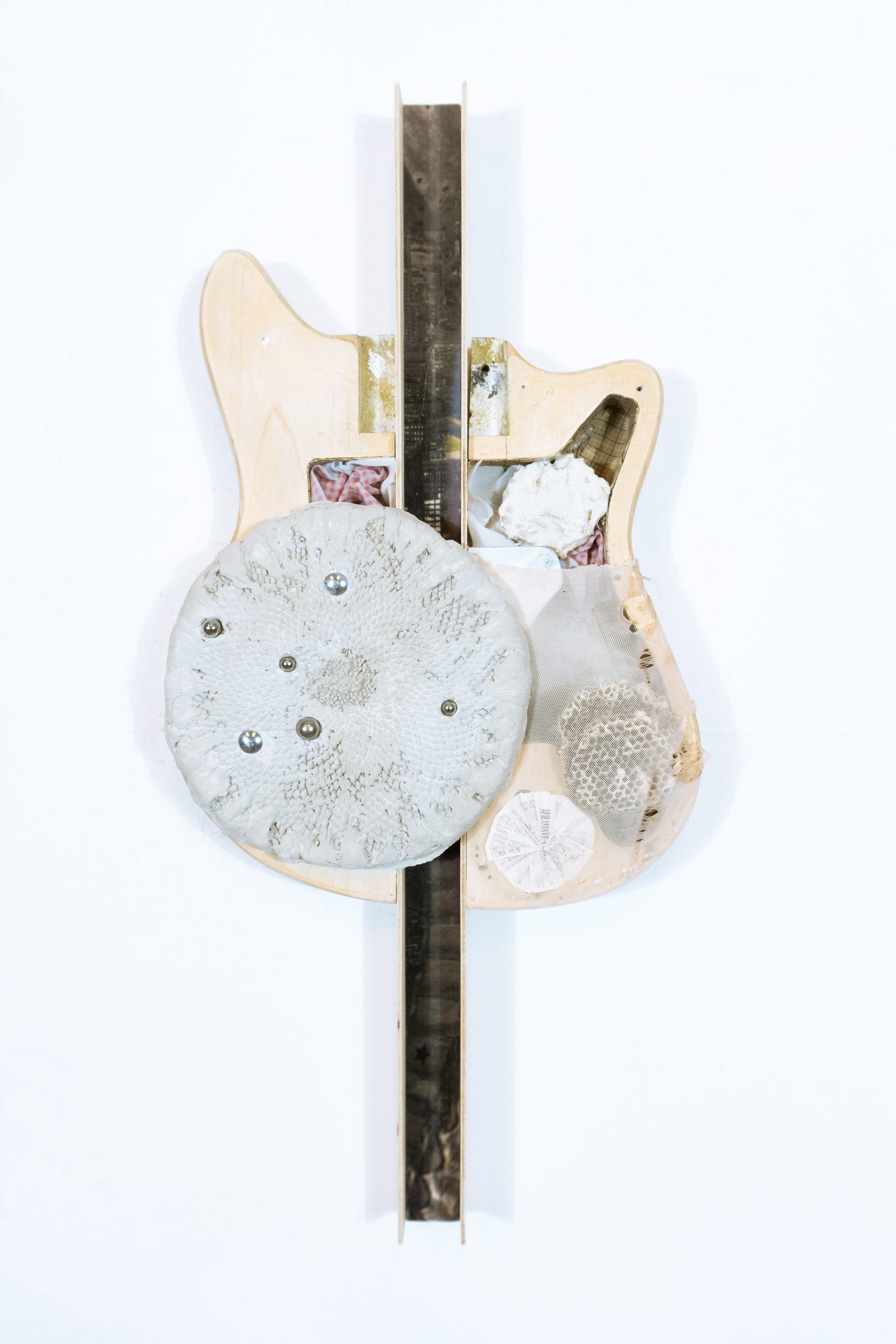
A trove of heavily modified guitars populates the space. This marks an important connection between body and instrument, drawing parallels between both shape and operation. They’re essentially dysfunctional in their current state, as they’ve been broken, respun, with connections made to a natural order. Here the artist introduces the question, how does one confront a thing that is divorced from its original “use value”? She also seeks to connect somatic and environmental happenings, breaking up divisions between interior and exterior.
Returning to Baudrillard’s premise, "An object's functionality is the very thing that enables it to transcend its main 'function' in the direction of a secondary one, to play a part, to become a combining element, an adjustable item, within a universal system of signs.” In keeping with that insight, Bąk probes the space beyond utility, unmooring her materials from singular functions and prescribed ideologies. She thus transcends the role of the collector by exploring her objects’ active potential. Excited by the intermingling and merging of different contexts, Bąk activates inherent properties while tracing associations, opening pathways to new material possibilities.
A particularly imaginal corner of Bąk’s practice revolves around her collection of visual fragments—from magazines, newspapers, the internet, and her own photographs—that convey recurring motifs. She seeks images that are particularly vibrant, in which shiny aspirations might be contrasted against hard realities. Such efforts induce pressure by way of contrast, puncturing veneers of perfection to expose the faultlines of ambition. Methods of re-signification clearly pulse through this cornerstone of the practice, aligning the collages with the aforementioned relational complexes.
Beyond the realm of object and image remix, Bąk also works directly with pigments on canvas. This format offers a space of freedom apart from language and conceptualization, an expressive playground where she can roam, cataloging impulses and affect through color and texture. Her large-scale, multimedia abstractions also subtly refer to the body through shades of brown and red, which are weighed against metallics. Still, the work errs on nonresolution, suspended in nonobjective space, a result of her recognition of painting’s status as a “rag.” She moves her canvases around on the floor, largely abandoning the brush, and pursuing a more bodily approach to composing.
Traversing the exhibition, one encounters destabilized objects, reconfigured image-worlds, and paintings vibrating with expressive activity. Bąk attends to the machine-like operations within and across each medium, orchestrating their parts toward a cohesive whole, guided by the spectrum between freedom and discrete articulation. She emphasizes the contingency of function, the imposition of use, and the rerouting of systems, all while engaging in deeply affective explorations of material.
Reilly Davidson
The exhibition is supported by Istituto Polacco di Roma and Consulate General of the Republic of Poland in Milan.
Ania Bąk (b. 1984, Poland) works across painting, sculpture, and sound. Her practice engages with the politics of matter, embodiment, and perception. Using organic and industrial materials — glass pellets, silicone, foil, fabric, glue — Bąk creates porous surfaces and unstable structures that resist fixed categorization. Rooted in tactile and process-based experimentation, where layering, decomposition, and reconfiguration operate as both formal strategies and metaphors for precarity, transformation, and sensory multiplicity. Emerging from the post-industrial landscape of Łódź - once a center of textile manufacturing and a historical site of both labor exploitation and radical artistic experimentation - Bąk’s work resonates with the legacy of the Polish constructivist avant-garde while subverting its utopian clarity. In her compositions, geometry is not a system of order but a structure under pressure: softened, warped, or destabilized through embodied gesture and environmental influence. Influenced by feminist materialism, her abstraction favors ambiguity and flux over fixed meaning, embracing the instability of lived experience in late capitalism. Rather than offering resolution, Bąk creates speculative environments where viewers are invited to engage through intuition, sensation, and affect — proposing an aesthetic of openness grounded in fragility, divergence, and the generative potential of the uncertain.
Recent exhibitions: Turnus Gallery, Warsaw; Zachęta National Gallery, Warsaw; Christine Koenig Galerie, Vienna; 17th International Triennale of Tapestry at Central Museum of Tapestry, Łódź; Muzeum Sztuki, Łódź; Skala Gallery, Poznan. Her works are in the collection of Muzeum Sztuki in Lodz and private ones.
Reilly Davidson is a writer, curator, and interdisciplinary artist based in Brooklyn, New York. Her practice is largely research-based, working in both video and tactile poetry, with a distinct focus on capturing an “instant-now.” Her writing has appeared in KALEIDOSCOPE, Artforum and The Brooklyn Rail. She has organized exhibitions across U.S. and international venues, including Martos Gallery, CLEARING and Shoot the Lobster.
Building on the relational and perceptual life of things, Ania Bąk examines the contours of origins, pushing her artifacts into new frontiers. She is attuned to the latent potential stored within any given form, seeking pieces of reality that can be shifted through various transformational processes. Her practice touches upon a certain hybrid spirit that characterizes the present moment. Objects and images are constantly borrowed, appropriated, reinterpreted, and transformed in efforts to activate new meanings and relations.
A trove of heavily modified guitars populates the space. This marks an important connection between body and instrument, drawing parallels between both shape and operation. They’re essentially dysfunctional in their current state, as they’ve been broken, respun, with connections made to a natural order. Here the artist introduces the question, how does one confront a thing that is divorced from its original “use value”? She also seeks to connect somatic and environmental happenings, breaking up divisions between interior and exterior.
Returning to Baudrillard’s premise, "An object's functionality is the very thing that enables it to transcend its main 'function' in the direction of a secondary one, to play a part, to become a combining element, an adjustable item, within a universal system of signs.” In keeping with that insight, Bąk probes the space beyond utility, unmooring her materials from singular functions and prescribed ideologies. She thus transcends the role of the collector by exploring her objects’ active potential. Excited by the intermingling and merging of different contexts, Bąk activates inherent properties while tracing associations, opening pathways to new material possibilities.
A particularly imaginal corner of Bąk’s practice revolves around her collection of visual fragments—from magazines, newspapers, the internet, and her own photographs—that convey recurring motifs. She seeks images that are particularly vibrant, in which shiny aspirations might be contrasted against hard realities. Such efforts induce pressure by way of contrast, puncturing veneers of perfection to expose the faultlines of ambition. Methods of re-signification clearly pulse through this cornerstone of the practice, aligning the collages with the aforementioned relational complexes.
Beyond the realm of object and image remix, Bąk also works directly with pigments on canvas. This format offers a space of freedom apart from language and conceptualization, an expressive playground where she can roam, cataloging impulses and affect through color and texture. Her large-scale, multimedia abstractions also subtly refer to the body through shades of brown and red, which are weighed against metallics. Still, the work errs on nonresolution, suspended in nonobjective space, a result of her recognition of painting’s status as a “rag.” She moves her canvases around on the floor, largely abandoning the brush, and pursuing a more bodily approach to composing.
Traversing the exhibition, one encounters destabilized objects, reconfigured image-worlds, and paintings vibrating with expressive activity. Bąk attends to the machine-like operations within and across each medium, orchestrating their parts toward a cohesive whole, guided by the spectrum between freedom and discrete articulation. She emphasizes the contingency of function, the imposition of use, and the rerouting of systems, all while engaging in deeply affective explorations of material.
Reilly Davidson
The exhibition is supported by Istituto Polacco di Roma and Consulate General of the Republic of Poland in Milan.
Ania Bąk (b. 1984, Poland) works across painting, sculpture, and sound. Her practice engages with the politics of matter, embodiment, and perception. Using organic and industrial materials — glass pellets, silicone, foil, fabric, glue — Bąk creates porous surfaces and unstable structures that resist fixed categorization. Rooted in tactile and process-based experimentation, where layering, decomposition, and reconfiguration operate as both formal strategies and metaphors for precarity, transformation, and sensory multiplicity. Emerging from the post-industrial landscape of Łódź - once a center of textile manufacturing and a historical site of both labor exploitation and radical artistic experimentation - Bąk’s work resonates with the legacy of the Polish constructivist avant-garde while subverting its utopian clarity. In her compositions, geometry is not a system of order but a structure under pressure: softened, warped, or destabilized through embodied gesture and environmental influence. Influenced by feminist materialism, her abstraction favors ambiguity and flux over fixed meaning, embracing the instability of lived experience in late capitalism. Rather than offering resolution, Bąk creates speculative environments where viewers are invited to engage through intuition, sensation, and affect — proposing an aesthetic of openness grounded in fragility, divergence, and the generative potential of the uncertain.
Recent exhibitions: Turnus Gallery, Warsaw; Zachęta National Gallery, Warsaw; Christine Koenig Galerie, Vienna; 17th International Triennale of Tapestry at Central Museum of Tapestry, Łódź; Muzeum Sztuki, Łódź; Skala Gallery, Poznan. Her works are in the collection of Muzeum Sztuki in Lodz and private ones.
Reilly Davidson is a writer, curator, and interdisciplinary artist based in Brooklyn, New York. Her practice is largely research-based, working in both video and tactile poetry, with a distinct focus on capturing an “instant-now.” Her writing has appeared in KALEIDOSCOPE, Artforum and The Brooklyn Rail. She has organized exhibitions across U.S. and international venues, including Martos Gallery, CLEARING and Shoot the Lobster.
11
febbraio 2026
Ania Bak – Result of Influence
Dall'undici febbraio al 10 marzo 2026
arte contemporanea
Location
EASTCONTEMPORARY
Milano, Via Giuseppe Pecchio, 3, (MI)
Milano, Via Giuseppe Pecchio, 3, (MI)
Orario di apertura
da martedì a sabato ore 15-19
Vernissage
11 Febbraio 2026, 17-20
Autore
Autore testo critico