Create an account
Welcome! Register for an account
La password verrà inviata via email.
Recupero della password
Recupera la tua password
La password verrà inviata via email.

-
- container colonna1
- Categorie
- #iorestoacasa
- Agenda
- Archeologia
- Architettura
- Arte antica
- Arte contemporanea
- Arte moderna
- Arti performative
- Attualità
- Bandi e concorsi
- Beni culturali
- Cinema
- Contest
- Danza
- Design
- Diritto
- Eventi
- Fiere e manifestazioni
- Film e serie tv
- Formazione
- Fotografia
- Libri ed editoria
- Mercato
- MIC Ministero della Cultura
- Moda
- Musei
- Musica
- Opening
- Personaggi
- Politica e opinioni
- Street Art
- Teatro
- Viaggi
- Categorie
- container colonna2
- Servizi
- Sezioni
- container colonna1



Fuit Hic
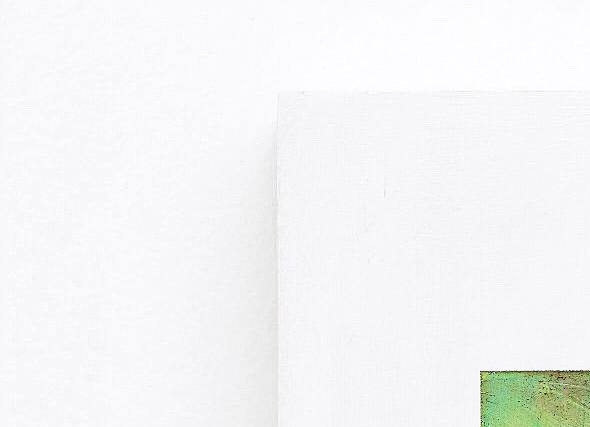
Immagini affiorano da un bianco attivo, non sfondo ma campo di tensione. Il vuoto trattiene e amplifica il senso, rallentando lo sguardo. Le opere si richiamano in un circuito silenzioso, dove visione e presenza si riflettono e si trasformano.
Comunicato stampa
Segnala l'evento
(…) mentre fuori
tutto si agita e si torce qui
niente fa una grinza e le forme del vuoto
si svelano più facilmente
(While outside
everything writhes and twists here
nothing so much as creases, and the shapes of emptiness
reveal themselves more easily)
Remo Pagnanelli, Nel salone
Space is never neutral. What surrounds a work conditions how it is received, how long it holds attention, how meaning accumulates or dissolves. The void is not what remains once the painting has been placed, but what the painting unfolds: the distance that makes looking possible, and allows meaning to gather rather than dissipate. Where does the painting end and the wall begin? It is a question Hannah-Sophia Guerriero refuses to resolve, with her miniature paintings on pine wood inscribed within a field of deliberate white.
I like to think of Hannah's miniatures as brief poems suspended across the white page of the wall, held in delicate intervals of silence. When the poet Mallarmé asked his publisher Mendès to leave a grand blanc between his poems, he was asking for breath — a space to be crossed with effort, so that each composition might return to the reader the singular pleasure that belongs to it, without dissolving into the flow of what precedes and follows. The page blanche, wrote Thibaudet in his commentary on Mallarmé's poetics, is not white because of its emptiness, but because of its fullness: the perfection of an unwritten mystery. Like lines within a single composition, her works call to one another across the room, where the wall itself serves as a field that by turns receives and releases the image, allowing one work to recede as another quietly comes forward.
Hannah's paintings are minute, yet the room expands them in both time and perception. The miniature imposes a physiological slowness: your body must shift, your eyes must adjust, drawing nearer until you sense the verge between the material surface and your own capacity to receive it. How many hours of looking, of layering, of patient practice has Guerriero poured into these few centimetres of pine wood? By co-opting the proportions of the handheld screen while demanding the concentration of historical painting, these works subvert contemporary expectations of speed. Many of Hannah's paintings begin as photographic notations, and what the camera arrests in a fraction of a second, the brush returns to duration: layer by layer, glaze by glaze, until a fleeting glance condenses into painted memory.
In 1434, Jan van Eyck signed the Arnolfini Portrait not along the edge of the panel nor discreetly in a corner, but at the exact centre of the painted wall, above a convex mirror. Johannes de Eyck fuit hic, "Jan van Eyck was here". The mirror, small as an eye at the heart of the painting, reflects the entire room from the opposite side. It does not show what the painting already shows. It reveals what the painting cannot see of itself. Guerriero appropriates this optical device and reframes it. In Underfold (2026), the convex mirror of the Arnolfini Portrait is emptied of its Flemish bourgeois figures and refilled with presences that belong to the exhibition itself: the pointing hand of Observer (2026), the flowers. What van Eyck used to fold the outside world into the painting, Guerriero uses to fold the works into each other. The mirror no longer opens onto a room beyond the picture plane, but onto the other paintings on the wall. The three works thereby establish a circular conversation: the hand in Observer gestures outward, the mirror in Underfold catches and returns that gesture, and In Situ (2025), suspended between them, holds the landscape from which their shared imagery emerges — flowers glimpsed through a window in southern Italy, colours intensified until they exceed their source, edges softened and dissolved into the surrounding surface until image and memory become indistinguishable. Each painting is at once origin and destination of the others' gaze. The system is self-contained, sealed, complete.
In Hannah's works, details, landscapes, fragments of memory surface from a painted white not serving as background, but as a void deliberately constructed around the image, a field of silence and light from which representation slowly emerges. It is from this sense of the painted void that her ongoing research into the relationship between image and surrounding space begins, a line of inquiry that, since 2024, has been articulated through the exploration of the notion of lacuna. In the field of painting conservation, a lacuna marks an interruption in the pictorial surface, a fragment lost. In Hannah's work, however, this notion does not register as absence; it activates a space of potential, where the void intensifies meaning, holding the tension between the works and allowing their relations and internal rhymes to resonate. Approaching Hannah's paintings, one gradually senses that this circular conversation does not belong to the images alone. It extends to the viewer who enters the field of their attention.
Fuit hic — was here. And now, you are here too.
_____________
Hannah-Sophia Guerriero (b. 2002, Oldham, UK) is a UK-based painter whose work is held in several private collections, including the Ryan Taylor Collection. Working in the legacy of Northern Renaissance precision, her practice interrogates the contemporary sublime through the mechanics of scale, attention, and duration. By either distilling dense materiality into the proportions of the handheld screen or marooning fragments within an expansive void, Guerriero generates a spatial excess that counters the visual saturation of digital culture. Through strategies of glazing, veiling, and formal restraint, she stages the painting as both image and object—holding the viewer within a paradox of intimacy and inaccessibility. This is a commitment to the slow image: a mode of resistance where meaning emerges through the reclaimed necessity of a singular gaze.
In 2024, she completed Louise Giovanelli's Apollo Painting School programme. In 2025, Guerriero was selected for the Artworks Special feature in GalleriesNow (April edition). She is currently completing her BA in Painting and Printmaking at The Glasgow School of Art.
Selected exhibitions include: 2026, Apollo Painting School: 2024 & 2025 Cohorts, The Grundy Museum and Gallery, Blackpool; Apollo Painting School: 2024 & 2025 Cohorts, Alice Amati, London; 2025, Veils of Space, Alma Pearl Gallery, London (solo); Interchange, Heav11n, Manchester; ALL THE SMALL THINGS II, Soup Gallery, London; In Residence, In Transit Chapter II, Museo Cambellotti, Latina, Italy; Apollo Painting School, Alice Amati, London; 2024, In Residenza, In Transito, Museo Cambellotti, Latina, Italy; 2023, Selected Ten Student Exchange, Hochschule für bildende Künste, Hamburg; 2020, Future Creatives 2020, Manchester Art Gallery, Manchester.
tutto si agita e si torce qui
niente fa una grinza e le forme del vuoto
si svelano più facilmente
(While outside
everything writhes and twists here
nothing so much as creases, and the shapes of emptiness
reveal themselves more easily)
Remo Pagnanelli, Nel salone
Space is never neutral. What surrounds a work conditions how it is received, how long it holds attention, how meaning accumulates or dissolves. The void is not what remains once the painting has been placed, but what the painting unfolds: the distance that makes looking possible, and allows meaning to gather rather than dissipate. Where does the painting end and the wall begin? It is a question Hannah-Sophia Guerriero refuses to resolve, with her miniature paintings on pine wood inscribed within a field of deliberate white.
I like to think of Hannah's miniatures as brief poems suspended across the white page of the wall, held in delicate intervals of silence. When the poet Mallarmé asked his publisher Mendès to leave a grand blanc between his poems, he was asking for breath — a space to be crossed with effort, so that each composition might return to the reader the singular pleasure that belongs to it, without dissolving into the flow of what precedes and follows. The page blanche, wrote Thibaudet in his commentary on Mallarmé's poetics, is not white because of its emptiness, but because of its fullness: the perfection of an unwritten mystery. Like lines within a single composition, her works call to one another across the room, where the wall itself serves as a field that by turns receives and releases the image, allowing one work to recede as another quietly comes forward.
Hannah's paintings are minute, yet the room expands them in both time and perception. The miniature imposes a physiological slowness: your body must shift, your eyes must adjust, drawing nearer until you sense the verge between the material surface and your own capacity to receive it. How many hours of looking, of layering, of patient practice has Guerriero poured into these few centimetres of pine wood? By co-opting the proportions of the handheld screen while demanding the concentration of historical painting, these works subvert contemporary expectations of speed. Many of Hannah's paintings begin as photographic notations, and what the camera arrests in a fraction of a second, the brush returns to duration: layer by layer, glaze by glaze, until a fleeting glance condenses into painted memory.
In 1434, Jan van Eyck signed the Arnolfini Portrait not along the edge of the panel nor discreetly in a corner, but at the exact centre of the painted wall, above a convex mirror. Johannes de Eyck fuit hic, "Jan van Eyck was here". The mirror, small as an eye at the heart of the painting, reflects the entire room from the opposite side. It does not show what the painting already shows. It reveals what the painting cannot see of itself. Guerriero appropriates this optical device and reframes it. In Underfold (2026), the convex mirror of the Arnolfini Portrait is emptied of its Flemish bourgeois figures and refilled with presences that belong to the exhibition itself: the pointing hand of Observer (2026), the flowers. What van Eyck used to fold the outside world into the painting, Guerriero uses to fold the works into each other. The mirror no longer opens onto a room beyond the picture plane, but onto the other paintings on the wall. The three works thereby establish a circular conversation: the hand in Observer gestures outward, the mirror in Underfold catches and returns that gesture, and In Situ (2025), suspended between them, holds the landscape from which their shared imagery emerges — flowers glimpsed through a window in southern Italy, colours intensified until they exceed their source, edges softened and dissolved into the surrounding surface until image and memory become indistinguishable. Each painting is at once origin and destination of the others' gaze. The system is self-contained, sealed, complete.
In Hannah's works, details, landscapes, fragments of memory surface from a painted white not serving as background, but as a void deliberately constructed around the image, a field of silence and light from which representation slowly emerges. It is from this sense of the painted void that her ongoing research into the relationship between image and surrounding space begins, a line of inquiry that, since 2024, has been articulated through the exploration of the notion of lacuna. In the field of painting conservation, a lacuna marks an interruption in the pictorial surface, a fragment lost. In Hannah's work, however, this notion does not register as absence; it activates a space of potential, where the void intensifies meaning, holding the tension between the works and allowing their relations and internal rhymes to resonate. Approaching Hannah's paintings, one gradually senses that this circular conversation does not belong to the images alone. It extends to the viewer who enters the field of their attention.
Fuit hic — was here. And now, you are here too.
_____________
Hannah-Sophia Guerriero (b. 2002, Oldham, UK) is a UK-based painter whose work is held in several private collections, including the Ryan Taylor Collection. Working in the legacy of Northern Renaissance precision, her practice interrogates the contemporary sublime through the mechanics of scale, attention, and duration. By either distilling dense materiality into the proportions of the handheld screen or marooning fragments within an expansive void, Guerriero generates a spatial excess that counters the visual saturation of digital culture. Through strategies of glazing, veiling, and formal restraint, she stages the painting as both image and object—holding the viewer within a paradox of intimacy and inaccessibility. This is a commitment to the slow image: a mode of resistance where meaning emerges through the reclaimed necessity of a singular gaze.
In 2024, she completed Louise Giovanelli's Apollo Painting School programme. In 2025, Guerriero was selected for the Artworks Special feature in GalleriesNow (April edition). She is currently completing her BA in Painting and Printmaking at The Glasgow School of Art.
Selected exhibitions include: 2026, Apollo Painting School: 2024 & 2025 Cohorts, The Grundy Museum and Gallery, Blackpool; Apollo Painting School: 2024 & 2025 Cohorts, Alice Amati, London; 2025, Veils of Space, Alma Pearl Gallery, London (solo); Interchange, Heav11n, Manchester; ALL THE SMALL THINGS II, Soup Gallery, London; In Residence, In Transit Chapter II, Museo Cambellotti, Latina, Italy; Apollo Painting School, Alice Amati, London; 2024, In Residenza, In Transito, Museo Cambellotti, Latina, Italy; 2023, Selected Ten Student Exchange, Hochschule für bildende Künste, Hamburg; 2020, Future Creatives 2020, Manchester Art Gallery, Manchester.
28
marzo 2026
Fuit Hic
Dal 28 marzo al 03 maggio 2026
arte contemporanea
Location
DISPLAY
Parma, Vicolo al Leon d'Oro, 4A, (PR)
Parma, Vicolo al Leon d'Oro, 4A, (PR)
Orario di apertura
da lunedi a Domenica 0-24
Sito web
Autore
Curatore
Autore testo critico